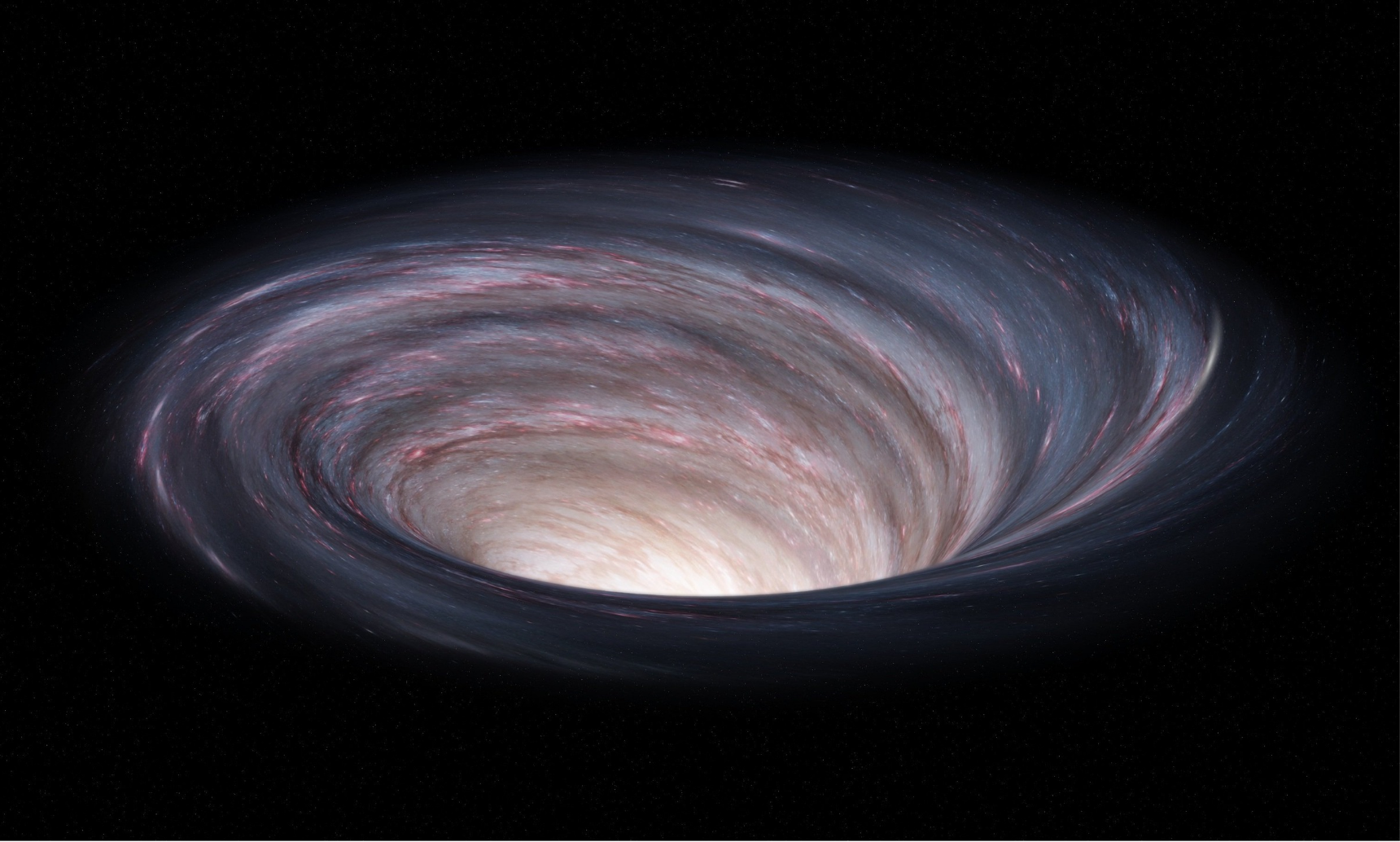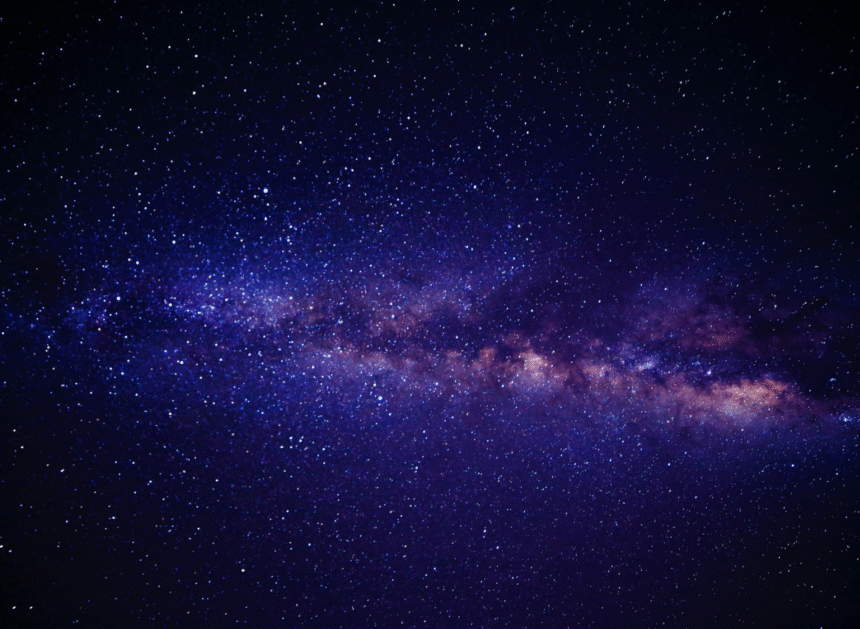
Picture intergalactic space: quiet, dark, and seemingly empty. Now imagine a filter that makes the universe’s hidden structure visible. The emptiness fills with faint lines, like a transparent grid stretched in every direction. It is not a rigid net; it bends, slides, and subtly streams. In this view, space is not just a stage—it is the structure that links distance, motion, and time.
Those lines would never sit still. Around anything massive—stars, gas clouds, and the extra pull of dark matter—the grid would sag and curve. It would resemble a slow river current, with nearby paths tilted inward. A passing galaxy would appear to follow the slope, because the “straight” route has been reshaped.
In a spacetime-visible universe, gravity would look like route-finding. Drop a pebble and it is not grabbed by a separate pull; it follows the local downhill direction of the grid. The steeper the slope, the more the grid seems to flow toward the mass. Near the densest objects, that flow becomes impossible to resist.
Zoom out and the whole grid would be stretching. Galaxies would appear to drift apart as the grid stretches between them. The distance between faraway galaxies would grow, so light crossing the gap would arrive with its waves lengthened, shifting toward red.
Measurements show the stretching is speeding up, as if spacetime has a gentle outward pressure. The label for that effect is dark energy, even though its cause remains uncertain.
Run the movie backward and the lines converge on a hotter, denser start about 13.8 billion years ago. In the first moments, spacetime would balloon outward, smoothing while keeping tiny wrinkles. For a brief fraction of a second, expansion raced ahead, then settled into a slower growth.
Those wrinkles became the seeds of today’s large-scale structure: filaments, clusters, and broad voids. Seeing spacetime would turn cosmic history into a living map.
Living on a Curved Current
Bring the view to the solar system and gravity looks less like a tug and more like geography. Near the Sun, the grid would dip, making the straightest routes curve inward. Planets keep moving forward, but their forward motion constantly meets that slope. An orbit is a controlled fall: missing the Sun in the same way, over and over.
Earth makes a smaller dip. The Moon loops along Earth’s curved lanes, and satellites stay up by skimming those same paths. The International Space Station is still “falling,” but it moves fast enough to keep missing the ground. To depart permanently, a spacecraft must reach a speed that escapes Earth’s curved routes—what people call escape velocity.
The visible grid would also clarify tides. Earth’s pull is stronger on the near side of the Moon than on the far side, so the slope changes across the Moon’s width. The same uneven slope stretches one direction and squeezes another, which is why the Moon drives tides. Earth’s rotation adds a small extra twist by dragging nearby spacetime along, an effect detectable with precise measurements.
Even inside Earth, the grid would point toward the center from every direction. Yet the planet does not cave in because rock and metal push back; internal pressure resists compression. At the core, inward pull and outward pressure balance.
At that balance point, in theory, an object could rest without drifting up or down. In a simple thought experiment—a frictionless tunnel through Earth—an object would speed up toward the center, then slow as it climbs the opposite side.
The Extreme Zones: Collapses, Ripples, Clues
The grid’s most dramatic shapes show up when stars run out of fuel. A Sun-like star is expected to shed its outer layers and leave a white dwarf, a dense remnant about the size of Earth. The expelled gas can glow as a planetary nebula, briefly outlining the star’s last stage. The central dip shrinks, but it does not vanish.
More massive stars end in a supernova, flinging newly made elements into space. Their crushed cores can become neutron stars: roughly twice the Sun’s mass packed into a sphere only tens of kilometers wide. Around such an object, the grid would be steep and tightly stacked. Close passes would feel intense tidal stretching, and light would follow noticeably bent paths.
These leftovers are more than cosmic landmarks. They act as stress tests, because matter is squeezed to extremes and spacetime is curved. Neutron stars can spin rapidly and send clock-like radio pulses. Tracking those pulses helps scientists test gravity in extreme conditions.
If the core is heavier still, collapse continues into a black hole. In the grid view, the inward flow becomes so extreme that beyond a boundary, every future path points inward. Light cannot escape because “out” no longer exists as a usable direction there. Outside the boundary, gas and dust can form a hot, bright accretion disk as they spiral down.
Near a black hole, tidal forces can become extreme, stretching objects lengthwise and compressing them sideways—spaghettification in the most literal sense. Deeper in lies the singularity, where current theories stop being reliable.
If the black hole spins, it drags the surrounding grid into a swirl, forcing nearby matter to rotate. Ideas about exotic exits make headlines, but they remain speculative and are not expected to describe most real systems.
Spacetime also carries news. When heavy objects accelerate, they send out gravitational waves—ripples that travel at light speed and gently squeeze and stretch distances.
On September 14, 2015, detectors on Earth recorded the first clear signal, produced by two merging black holes. The distortion was smaller than an atom across a multi-kilometer instrument, yet it was enough to confirm a major prediction. If spacetime were visible, those ripples would be the universe’s most precise breaking-news ticker.