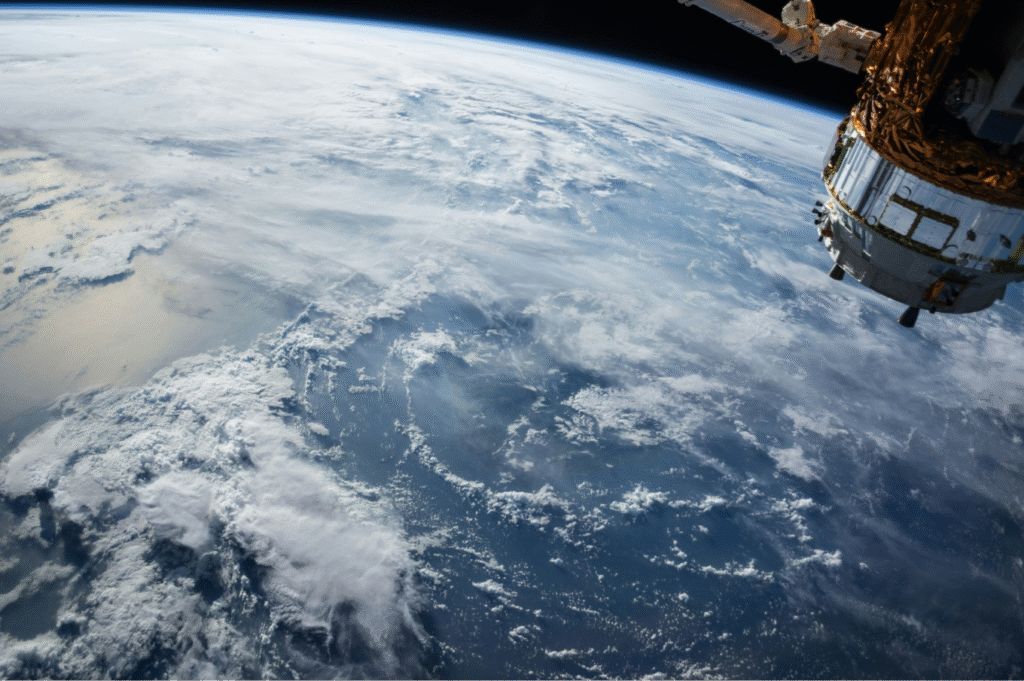
Scientists have found a new way to measure the height and structure of the planet’s forests. Using lasers, they can create a 3‑D model of the forests from space.
How the lasers work
The lasers are called “lidar,” which is a short form of “light detection and ranging.” They work in a similar way to radar, which is used to measure things like speed, but they use laser light instead of radio waves. The instrument is called the Global Ecosystem Dynamics Investigation, or GEDI for short. GEDI was delivered to the International Space Station in late 2018.
GEDI uses a system of laser beams to map the canopy height of Earth’s forests. The system sends out rapid pulses from three lasers that fire 242 times per second.
Each laser illuminates a footprint about 25 to 30 meters wide on the ground, and optics split the three beams into eight parallel ground tracks, with each footprint spaced about 60 meters apart along the track and about 600 meters across the track, creating a total swath of about 4.2 kilometers.
During its nominal mission, GEDI was expected to produce about 10 billion cloud‑free observations of Earth’s forests.
The laser beams ricochet off the first thing they hit, which can be a leaf atop a dense canopy, a protruding branch, or the ground from which the forest emerges. The energy returned to the GEDI telescope provides an intricate three‑dimensional map of forest canopies.
Bryan Blair, GEDI’s instrument scientist and deputy principal investigator, explained that they can send out a pulse of light, watch it reflect off the surface, and measure how tall the tree is and how dense the canopy becomes as the signal travels downward.
Forest canopy height has implications for the carbon cycle
The height and density of forests matter because knowing these two key factors allows scientists to estimate how much carbon is stored in a forest and how much will be released if those trees are cut down.
Ralph Dubayah, a remote sensing scientist at the University of Maryland and GEDI’s principal investigator, noted that the amount of carbon held in the land surface by trees, and how it has changed over time through disturbance and regrowth, remains the least understood aspect of the global carbon cycle.
Before GEDI, scientists relied on older laser data that was nearly two decades old and included only about five million measurements from all tropical forests combined. GEDI changed that by providing six million measurements per day, enabling researchers to investigate canopy structure in ways that were not possible before.
The new data shows that forest canopy structure is closely tied to overall forest health and the ability to use sunlight and other resources. Taller canopies generally indicate higher carbon storage, greater above‑ground biomass, and a stronger capacity to buffer the local microclimate, according to Shaoqing Liu, a Harvard University postdoctoral fellow who has studied forest canopies using GEDI data.
Climate, topography, and geology together explain almost three quarters of tropical forest canopy height variation, Liu said. Factors such as elevation, the length of a region’s dry season, and the amount of solar radiation received all contribute to how tall a forest’s canopy grows.
In the southern Amazon, the length of the dry season is the main driver of canopy height, placing this area at a high risk of canopy shrinkage because climate models project longer dry seasons in the future. In the central Amazon and parts of Africa, elevation plays a larger role than drought or heat.
GEDI provides insight into how the removal of trees affects the carbon budget of the atmosphere
With a global picture of how much mass trees contain in their trunks, branches, and leaves, GEDI data helps scientists understand how deforestation and land‑cover change affect the atmosphere’s carbon budget and how forests contribute to climate change. The same measurements also support modeling of biodiversity patterns worldwide.
Paul Moorcroft, a senior author on the Harvard study, emphasized that forests influence climate in multiple ways and that understanding their role in weather patterns is especially important as the climate changes.
Because tropical forests are both biodiversity hotspots and critical carbon stores, Liu added that protecting them serves both conservation and climate goals. He expressed hope that this work will help policy‑makers identify regions most vulnerable to climate change and direct protection efforts accordingly.