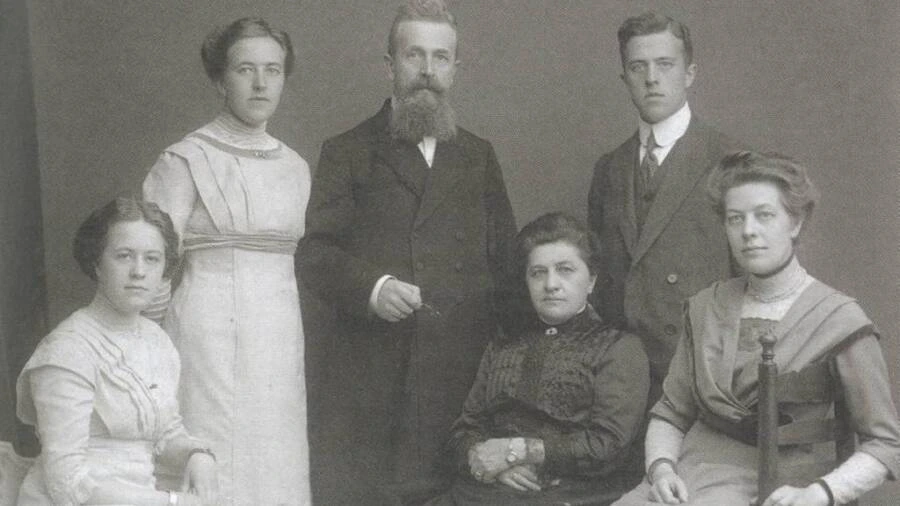
From 1940 to 1944, Corrie ten Boom and her family turned their quiet home in the Netherlands into a hiding place for Jews fleeing the Nazis. Above their little watch shop in Haarlem, they built a secret room. A narrow space tucked behind a wall, hidden from view. In that cramped area, Corrie, her sister Betsie and their father Casper would save the lives of hundreds.
A Family of Faith and Purpose
Corrie ten Boom, whose full name was Cornelia Arnolda Johanna ten Boom, was born on April 15, 1892. She grew up surrounded by ticking clocks and strong Christian faith. Corrie was the youngest of four children in a kind and religious family. They were Calvinists and they believed that helping others was one of the most important things a person could do.
Their home above her father Casper’s watch shop on Barteljorisstraat was always filled with laughter, prayer and a strong sense of purpose.
“I had always felt happy in this little shop, with its tiny voices and shelves of small shining faces,” ten Boom later wrote in her memoir The Hiding Place.
Corrie adored her father, a patient and kind man with what she called a “mystic rapport with the harmonies of watchworks.” After her mother’s death and a heartbreak, Corrie threw herself into her work, determined to master the craft.
In 1922, she became the first licensed female watchmaker in the Netherlands. Alongside her work, she led a youth club for girls, teaching Bible lessons and life skills. For a time, life in Haarlem was peaceful. But that peace wouldn’t last.
The Nazis Invade Holland
In May 1940, everything changed. Over just seven days, Germany invaded and occupied the Netherlands. By May 17th, the Nazis had taken control and life for Jewish citizens quickly turned grim. Corrie remembered the fear spreading through the city — the arrests, the disappearances, the sound of boots in the streets.
“At any minute there might be a rap on this door,” she thought while visiting Jewish friends. “These children, this mother and father, might be ordered to the back of a truck.”
The ten Booms, guided by faith and conscience, couldn’t stand by. When a Jewish woman named Kleermaker came to them for help, Casper ten Boom simply said, “In this household, God’s people are always welcome.”
Word of their compassion spread quickly. Soon, strangers began arriving at their door, terrified and desperate. The family joined the Dutch resistance and transformed their home into a refuge. A small secret room was built behind a false wall in Corrie’s bedroom, barely the size of a closet but large enough to hide six people. It even had a ventilation system to provide air during raids.
The ten Booms also installed a buzzer system that warned their guests to hide when danger approached. Despite the constant risk, the atmosphere inside the house often felt surprisingly lighthearted. Those in hiding would play music or rehearse small plays to keep spirits up. But beyond those walls, the war crept closer.
The Betrayal
On February 28, 1944, their luck ran out. A Dutch informant betrayed them and the Gestapo stormed the house. Corrie, her sister Betsie and their father Casper were arrested but the Nazis never found the people hiding in the secret room.
The family was taken to prison along with about 30 others. One guard offered 84-year-old Casper a chance to go home if he promised to stop helping Jews. Casper’s reply was simple: “If I go home today, I will open my door again to any man in need who knocks.” Ten days later, he died in prison.
After months in Scheveningen prison, Corrie and Betsie were sent to the Vught concentration camp and then, in September 1944, to Ravensbrück — one of the most brutal camps in Germany, built specifically for women.
There, the sisters lived through unimaginable suffering. The camp was overcrowded and disease-ridden and Nazi guards carried out horrific experiments on prisoners. “We must tell people what we have learned here,” Betsie told Corrie as her health declined. “That there is no pit so deep that He is not deeper still.”
Betsie died on December 16, 1944, at the age of 59. Corrie was devastated but clung to her sister’s words. Twelve days later, she was miraculously released due to a clerical error. An error that saved her life. Soon after, all the women in her age group were sent to the gas chamber.
A Mission Of Forgiveness
When Corrie returned home after the war, the world she knew was gone. Her father and sister were dead and her city was scarred by loss. But her faith remained. She opened a rehabilitation center for Holocaust survivors and began sharing her message of forgiveness.
In 1947, while speaking at a church in Munich, she faced one of her former guards from Ravensbrück. “You mentioned Ravensbrück in your talk,” he said. “I was a guard in there.” He didn’t recognize her but she did. As he asked for forgiveness, Corrie hesitated — then took his hand.
“For I had to do it — I knew that,” she wrote later. “The message that God forgives has a prior condition: that we forgive those who have injured us.”
For the next three decades, Corrie ten Boom traveled to more than 60 countries, telling her story and preaching forgiveness. Her words inspired thousands, reminding the world of the power of faith even in horror.
By the time she died on April 15, 1983 — her 91st birthday — Corrie ten Boom had been honored as one of Yad Vashem’s Righteous Among the Nations, alongside her father and sister. Through their bravery, they helped save some 800 Jewish lives.
Corrie ten Boom’s story is one of quiet heroism — of a family who refused to let fear silence their faith. She was born and died on the same day, a perfect circle. In Jewish tradition, such symmetry is seen as a blessing. A sign of a life that has fulfilled its purpose. Corrie ten Boom surely did.
Sources
https://encyclopedia.ushmm.org/content/en/article/corrie-ten-boom