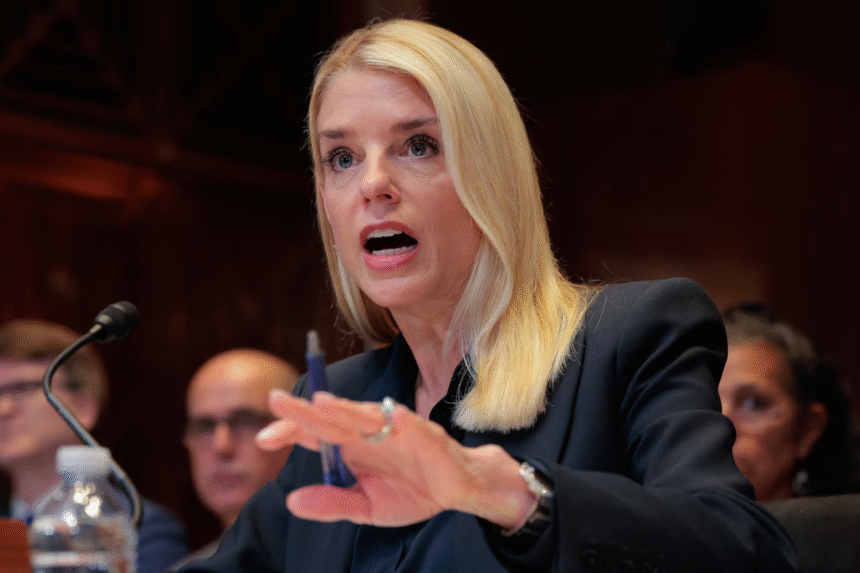
Republican lawmakers on the House Oversight Committee voted on Wednesday to subpoena Attorney General Pam Bondi. They want her to testify about how the Justice Department handled records connected to Jeffrey Epstein. The move shows that lawmakers are still asking questions about the case and about what information has or has not been released to the public.
The motion passed with a vote of 24–19. The committee is led by Republicans, and five members of the party joined Democrats to support the subpoena. The vote came after Representative Nancy Mace of South Carolina introduced the motion.
The Republicans who voted with Mace and the Democrats were Tim Burchett of Tennessee, Lauren Boebert of Colorado, Michael Cloud of Texas, and Scott Perry of Pennsylvania.
After the vote, the Justice Department did not immediately respond to requests for comment.
The vote came as questions continued about thousands of documents connected to Epstein’s case. Earlier on Wednesday, the Justice Department said that tens of thousands of Epstein-related files are currently “offline.” Officials said this is happening while they deal with redaction and privacy issues.
According to the department, the review process should be finished by the end of the week.
Nancy Mace strongly criticized the situation. She said the public has not yet seen all of the records that should have been released.
“AG Bondi claims the DOJ has released all of the Epstein files. The record is clear: they have not,” Mace wrote on X.
She also argued that the case still raises many unanswered questions.
“The Epstein case is one of the greatest cover-ups in American history. His global sex trafficking network is larger than what is being revealed. Three million documents have been released, and we still don’t have the full truth. Videos are missing. Audio is missing. Logs are missing. There are millions more documents out there. We want to know why the DOJ is more focused on shielding the powerful than delivering justice.”
After the vote, Mace spoke with reporters and explained why she pushed for the subpoena. She said Bondi had already testified before another committee, but not before the Oversight Committee.
“I know that Bondi has testified before the Judiciary Committee, but she’s not testified before me or the Oversight Committee. I need to get to the bottom of this for other survivors of Jeffrey Epstein.”
Mace also made it clear that she intends to ask detailed questions when Bondi appears before the committee.
“I have a lot more questions, and I don’t expect to be talking about the stock market, so she better not bring those notes when she comes to the Oversight Committee,” Mace said.
Her comment referred to a hearing held last month by the House Judiciary Committee. During that hearing, Bondi spoke about the performance of the stock market under President Donald Trump. The moment led to a tense exchange with lawmakers.
Mace explained that the subpoena calls for Bondi to give testimony behind closed doors. The session will be recorded on video, and the video will later be released to the public. At the moment, there is no date scheduled for the testimony.
The issue of the Epstein files has been debated for months in Congress. During the Judiciary Committee hearing last month, Bondi said the Justice Department had worked hard to release as much information as possible.
She described a large effort inside the department to review the records.
“More than 500 attorneys and reviewers spent thousands of hours painstakingly reviewing millions of pages to comply with Congress’s law. We’ve released more than 3 million pages, including 180,000 images, all to the public, while doing our very best in the time frame allotted by the legislation to protect victims,” Bondi said then.
Congress passed the law after the Justice Department and the FBI released a memo in July. In that memo, the agencies said they had completed an “exhaustive” review of the Epstein investigation files.
Officials said they would not bring charges against any additional people connected to Epstein’s sex trafficking ring. They also said they would not release any more information from the case.
Investigators said Epstein’s operation affected more than 1,000 victims.
However, the decision not to release more information led to strong criticism from lawmakers. Many members of Congress said the public deserved greater transparency.
In response, the Oversight Committee subpoenaed the Justice Department and ordered it to turn over the files to Congress.
The department later sent about 30,000 documents. But many lawmakers pointed out that most of those records had already been made public before.
Later that year, Congress passed the Epstein Files Transparency Act, also known as the EFTA. President Donald Trump signed the bill into law in November.
The law required the Justice Department to release the documents to the public within 30 days, although it allowed some limited exceptions.
At the end of January, Deputy Attorney General Todd Blanche announced that the department had released 3 million pages of files.
But he also said that roughly 3 million additional documents were being withheld. Blanche explained that many of the documents were duplicates. Others were being withheld for legal reasons.
He said the reasons included “various privileges, including deliberative process privilege, the work-product doctrine and attorney-client privilege.”
However, some lawmakers disagreed with that decision.
The bill’s co-authors, Representative Thomas Massie, a Republican from Kentucky, and Representative Ro Khanna, a Democrat from California, said the law requires those materials to be released.
They pointed to language in the law that requires the department to turn over “Internal DOJ communications, including emails, memos, meeting notes, concerning decisions to charge, not charge, investigate, or decline to investigate Epstein or his associates.”
Blanche also said that other withheld records include documents written in foreign languages and some that were sealed by judges.
Even after the release of millions of pages, many lawmakers and Epstein survivors have continued to criticize how the documents were handled.
One major concern has been the amount of redaction in the files. In many documents, information about possible accomplices was blacked out. At the same time, critics said some information about victims was not properly redacted.
The Justice Department has also faced criticism for taking down certain files multiple times. In some cases, the files were removed without a clear explanation.
Earlier this week, a Wall Street Journal article reported that tens of thousands of pages were missing from the collection of files.
After the report was published, a Justice Department spokesperson told NBC News that the department has not deleted any files.
“In compliance with the EFTA, our team is working around the clock to address victim concerns, redact personally identifiable information and any images of a sexual nature,” the statement said.
The department also explained that many files had been taken offline temporarily.
The spokesperson said that as of Monday, “47,635 files were offline for further review and should be ready for re-production by the end of the week. This is the most transparent Department of Justice in history, and all responsive documents will be repopulated online once proper redactions are made.”
Some of the missing documents involve interviews conducted by the FBI. According to an NBC News analysis of the Epstein files and information from a source familiar with the investigation, the missing records include summaries and notes from three interviews with a South Carolina woman.
The woman said she was a sexual assault victim of Epstein. She also made sexual abuse allegations against Donald Trump.
It is not clear whether those allegations were discussed in the other interviews that were not released.
When NBC News asked the White House for comment last week, officials pointed to a statement previously released by the Justice Department when the files first became public.
The statement said: “Some of the documents contain untrue and sensationalist claims against President Trump that were submitted to the FBI right before the 2020 election. To be clear, the claims are unfounded and false, and if they have a shred of credibility, they certainly would have been weaponized against President Trump already.”
Trump has not been accused of wrongdoing by law enforcement in connection with Epstein.
He has previously said that he stopped socializing with Epstein in the early 2000s.
According to Trump, he ended the relationship because he believed Epstein was a “creep.”