Two days before Christmas in 1974, three girls from Fort Worth climbed into a car for what should have been an unremarkable afternoon of holiday shopping. None of them ever came home.
An Uneventful Errand Before the Holiday
By December 1974, Fort Worth, Texas, had settled into its usual pre-Christmas bustle. Stores were packed, families were finishing their gift lists, and the season carried the same mix of hurry and cheer found in cities all across the country.
For most households nearby, these final days before Christmas meant little more than long shopping trips and looking forward to the holiday itself.
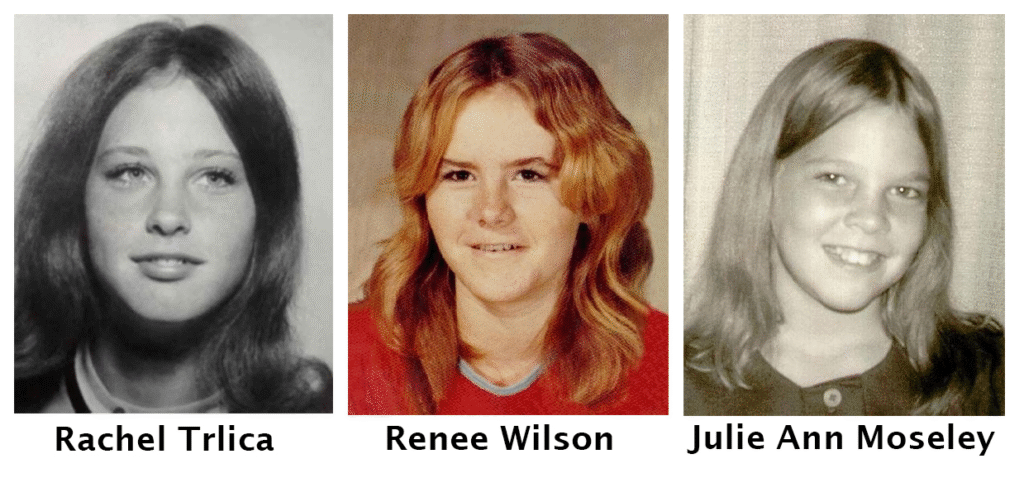
Rachel Trlica, seventeen, had arranged to spend that Monday afternoon with her close friend, fourteen-year-old Renee Wilson, at Seminary South Shopping Center — at the time, the biggest and best-known mall in the city. Their goal was to pick up a few last Christmas gifts.
Rachel had access to a car, a 1972 Oldsmobile, and the plan was to drive over, shop for a while, and be home well before evening.
Before the girls set out, Renee called her boyfriend, Terry Moseley, to see if he wanted to come along. He turned her down. It was then that Terry’s nine-year-old sister, Julie Ann Moseley, overheard the plan and asked to come in his place.
Rachel and Renee agreed, even though Julie Ann barely knew Rachel at all. What began as an offhand invitation turned the pair into a trio, and the three girls left together that morning in Rachel’s Oldsmobile. Nothing about the outing suggested anything but an ordinary errand.
Rachel had told her family she expected to be back by around four o’clock. Renee, for her part, already had evening plans of her own — she meant to join Terry at a party later that night. With a rough schedule set and a nearby destination in mind, the three left the neighborhood expecting to be gone only a few hours.
Their Final Known Stop
Before reaching the mall, the girls made a quick detour to a local Army-Navy surplus store, where they picked up a pair of jeans that had been held on layaway.
From there, they drove on to Seminary South Shopping Center and parked Rachel’s Oldsmobile on the mall’s upper parking level, close to the Sears entrance.
Once inside, the three girls were noticed by a number of people over the course of the afternoon.
Their presence at the mall that day is considered well established because witnesses independently recalled one specific, verifiable detail — Renee was wearing a shirt printed with the words “Sweet Honesty.”
Because this detail matched across multiple accounts, investigators were confident the girls really had spent time inside the shopping center that day.
At some point that afternoon, the three also made their way back to the parked car.
This much is known because of what was later found inside the locked Oldsmobile: several wrapped Christmas gifts apparently bought at stores in the mall, along with the jeans collected earlier from the Army-Navy store.
Beyond that, though, almost nothing could be pinned down with any certainty. No one could say for sure when they returned to the vehicle, how long they stayed there, or what they did immediately afterward.
Four o’clock came and went with no word from the girls, and their families grew increasingly uneasy.
Relatives drove to the shopping center, and by around six that evening, they found Rachel’s Oldsmobile exactly where she had left it — locked, with the shopping bags still inside, and no trace of the girls anywhere nearby. That same night, all three families contacted police to report them missing.
A Strange Letter Arrives on Christmas Eve
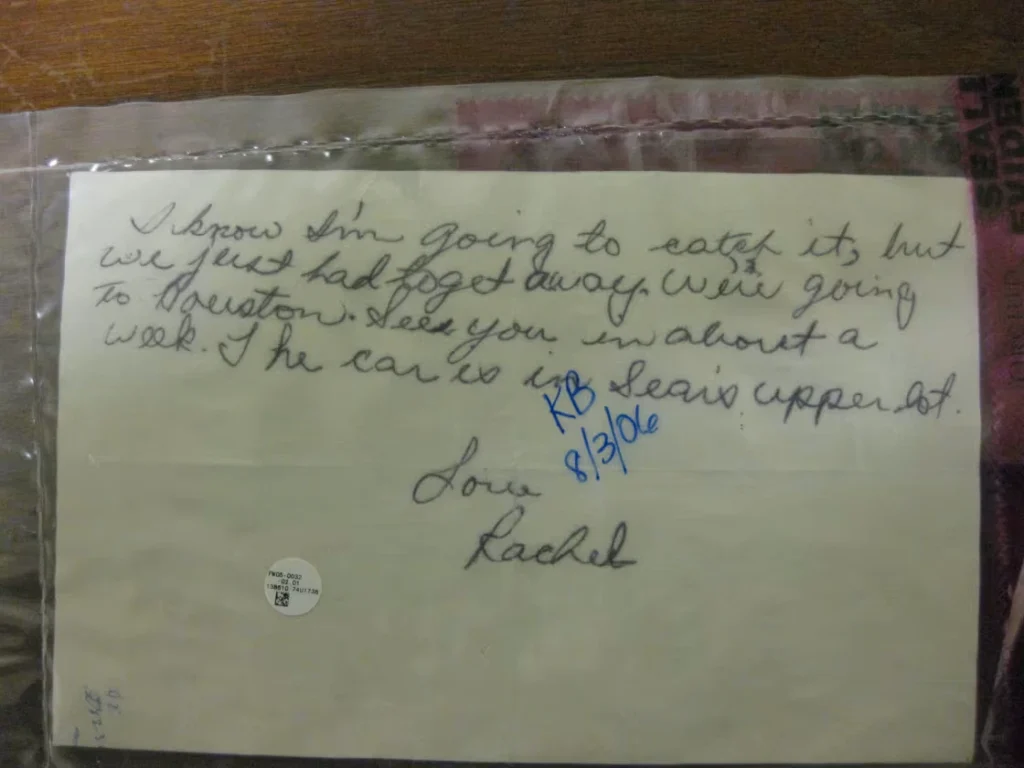
December 24 dawned with no news. When Tommy Trlica, Rachel’s husband, went out to check the mail that morning, he found an envelope waiting in the box.
It was addressed to him using his full formal name, and in the spot typically reserved for a return address, someone had written simply “Rachel.”
Inside was a short, handwritten note. It read: “I know I’m going to catch it, but we just had to get away. We’re going to Houston. See you in about a week. The car is in Sears Upper Lot. Love, Rachel.”
The note struck the family as wrong almost immediately. Rachel never called her husband by his given name, Thomas — to her, and to nearly everyone who knew him, he was “Tommy.”
The letter also went out of its way to explain where the car could be found, despite the fact that it had already been located by relatives the evening before. Taken together, these inconsistencies left Rachel’s family doubting she had written it at all.
Handwriting examiners later reviewed the letter, but their findings settled nothing — they could neither confirm nor rule out that Rachel had written it. There were also questions about how quickly the note had arrived in the first place.
Late December is typically one of the busiest stretches of the year for the postal service, yet the letter reached Tommy’s mailbox on Christmas Eve morning, just hours after the girls had been reported missing the night before.
A close look at the envelope only deepened the mystery further. The postmark’s town of origin wasn’t fully legible, since part of the postal code had been smudged.
Based on what could be made out, some who examined it believed the letter may have been mailed from Eliasville or Throckmorton, small towns well outside Fort Worth, while others read the blurred digits differently and thought they pointed instead toward Weatherford, Texas.
Whichever reading was correct, the postmark itself had been stamped and cancelled on the morning of December 24.
Despite the many red flags surrounding the letter — the wrong name, the unnecessary directions, the unexplained speed of delivery, and the disputed postmark — investigators settled early on a particular theory of the case.
With no obvious physical evidence pointing to foul play, and with two of the three missing being teenagers, police concluded that the girls had most likely left of their own accord.
That assumption would go on to shape how the investigation was handled for years afterward, during the critical early window when leads were freshest.
A Case That Went Cold
Missing persons cases were handled very differently in 1974 than they are today. There was no nationwide alert system for missing children at the time, and law enforcement routinely assumed that young people who vanished without any clear signs of violence had run away.
From nearly the beginning, that was the lens through which the disappearance of Rachel, Renee, and Julie Ann was viewed.
Unhappy with how slowly the official investigation was moving, the three families eventually pooled their resources to bring in outside help. In 1975, they hired private investigator Jon Swaim.
Over the months that followed, Swaim developed a lead suggesting the girls’ remains might be hidden somewhere along a swampy stretch of the Gulf Coast, and that spring he organized a search near Port Lavaca, Texas, bringing along roughly a hundred volunteers to comb the boggy ground beneath local bridges. Nothing turned up.
Swaim kept working the case for several more years. In 1979, he died of a drug and alcohol overdose that was ruled a suicide. Before his death, he had instructed that all of his personal case files be destroyed, and that instruction was carried out.
Whatever he had managed to uncover about the Fort Worth girls was lost for good along with those records.
For roughly two decades afterward, the case saw very little movement. The families never stopped searching for answers, but no real breakthroughs emerged. Then, in 1999, a second private investigator, Dan James, reached out to Rusty Arnold, Rachel’s younger brother.
James told Rusty he had already been quietly digging into the case on his own, even before he was formally approached by the family.
James claimed to have gathered eyewitness accounts placing Rachel and Renee — the two older girls — alive at several locations in the days immediately following their disappearance.
He suggested that someone had deliberately kept the pair away from Fort Worth and cut off from their families. James was guarded about specifics, and much of what he claimed to know stayed vague.
He also told Rusty that, by the time they spoke, Renee had likely died, but that Rachel might still be alive.
He described a reported sighting of Rachel around the Fort Worth area during the 1998 Christmas season, implying that she may have had a habit of returning to the region that time of year without ever making contact with her family.
James never offered solid proof for any of these claims, and the basis for his conclusions was never made fully public.
What the Witnesses Said
At different points over the decades, three separate people came forward to describe what they said they had witnessed in connection with the case.
The earliest account came from a woman who had reportedly been at the mall that same afternoon. She told a store clerk that she had seen three girls being hustled toward a pickup truck by unidentified men in the parking lot.
She never went to the police herself, and despite later efforts to track her down, investigators were never able to locate her for a formal interview.
A second witness surfaced years later, in 1981. He said that on the day the girls vanished, he had seen a girl being forced into a van in the mall’s parking lot.
When he approached the man involved to ask what was happening, he was told it was a family matter and that he should mind his own business. He backed off and didn’t intervene any further.
A third account came forward in 2001, describing events from later that same night. This witness said that around eleven-thirty in the evening, he saw all three girls sitting inside a pickup truck in the mall’s parking lot.
He identified the truck as belonging to a mall security guard, and recalled that the girls looked relaxed, showing no outward signs of fear or distress. He said he had reported what he saw to authorities back in 1974, but that nothing had ever come of it.
Working from the description this witness provided, investigators were able to identify a specific security guard who matched the details given. He was tracked down and formally questioned, and he denied ever having contact with the three girls that night.
Suspicion Within the Family
As the years passed without resolution, attention eventually turned toward people close to the victims — including Debra Arnold, Rachel’s older sister, who was nineteen at the time of the disappearance.
On the day of the shopping trip, Rachel had invited Debra to come along, but Debra chose to stay home instead. What later drew scrutiny to her was her living situation at the time. Debra was temporarily staying with Rachel and Tommy after a falling-out with her own boyfriend.
On its own, that arrangement might not have raised eyebrows — except for one additional detail.
Before marrying Rachel, Tommy had actually been engaged to Debra. That engagement ended, Tommy went on to marry Rachel instead, and Debra later found herself living under their roof.
In January 2000, the Fort Worth Star-Telegram ran a feature article on the case, and Debra agreed to be interviewed as part of it.
During that interview, she acknowledged that her brother Rusty had long suspected her of involvement and believed she was the one who had actually written the letter that arrived at Tommy’s mailbox on Christmas Eve morning.
Debra denied writing it, said she had no idea what had happened to her sister, and maintained that she had nothing to hide.
Not long after the article ran, the families of all three girls — Rusty Arnold, along with Richard and Judy Wilson, and RayAnn Moseley — sent Debra a formal written letter.
In it, they urged her to fully cooperate with the Fort Worth Police Department and the FBI, to submit to a polygraph test, and to answer any and all questions asked of her.
The letter also reminded her, pointedly, that Rachel was still her sister. Whether Debra ever responded to that appeal was never disclosed publicly.
Remembering Rachel, Renee, and Julie Ann
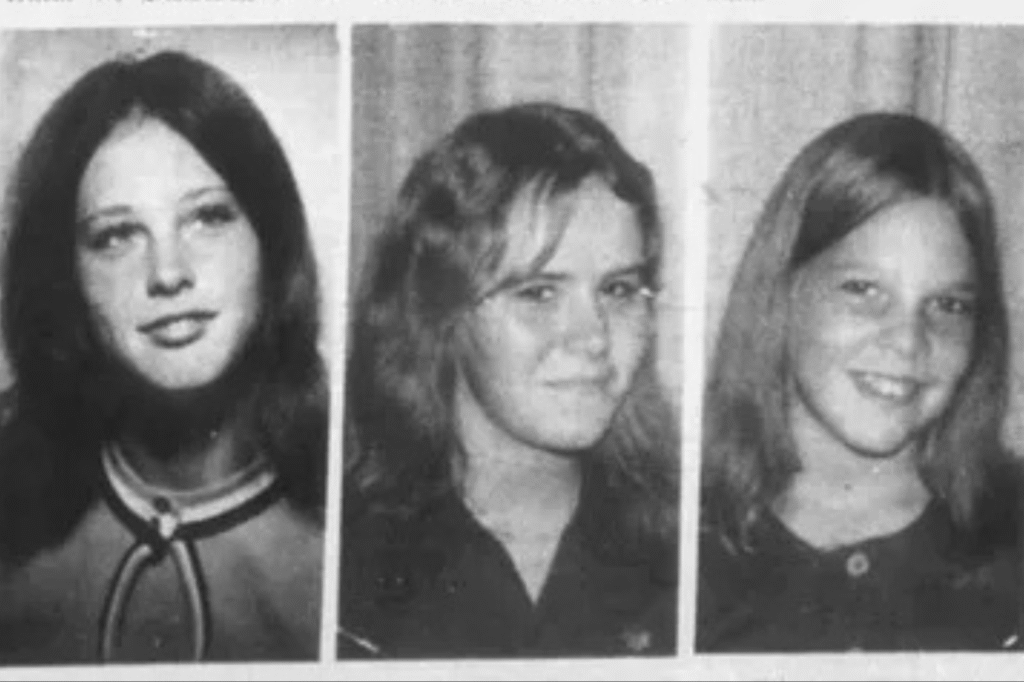
Rachel Trlica was seventeen years old when she disappeared on December 23, 1974. Young as she was, she had already stepped into adult life, having married Tommy Trlica only about six months earlier. Those who knew her described her as lively and warm.
Her brother, Rusty Arnold, went on to spend decades keeping her story before the public, pushing for answers that never came.
Renee Wilson was fourteen. She was outgoing and well liked, and she had a full evening ahead of her — she meant to go to a party with her boyfriend once she got back from the mall.
Her family, represented in later years by her parents, Richard and Judy Wilson, stayed actively involved for decades in efforts to keep the case in the public eye.
Julie Ann Moseley was only nine years old. Her presence on the shopping trip came about almost by chance, the result of a last-minute request to tag along with the older girls for the afternoon.
She was Terry Moseley’s youngest sister, and her family — represented in part by her mother, RayAnn Moseley — shared in the long, painful search for answers that consumed all three households for decades.
In December 2014, relatives of all three girls gathered in the parking lot of the former Seminary South Shopping Center to mark forty years since the disappearance.
Forty yellow balloons were released into the sky that day — one for every Christmas that had passed without an answer.
To this day, no arrests have ever been made, and no remains have ever been recovered, despite decades of tips, searches, and interviews carried out by local police, private investigators, and the families themselves.
The disappearance of Rachel Trlica, Renee Wilson, and Julie Ann Moseley on December 23, 1974, remains one of the most enduring unsolved missing persons cases in the history of Texas — a mystery that three families spent the rest of their lives trying to solve.