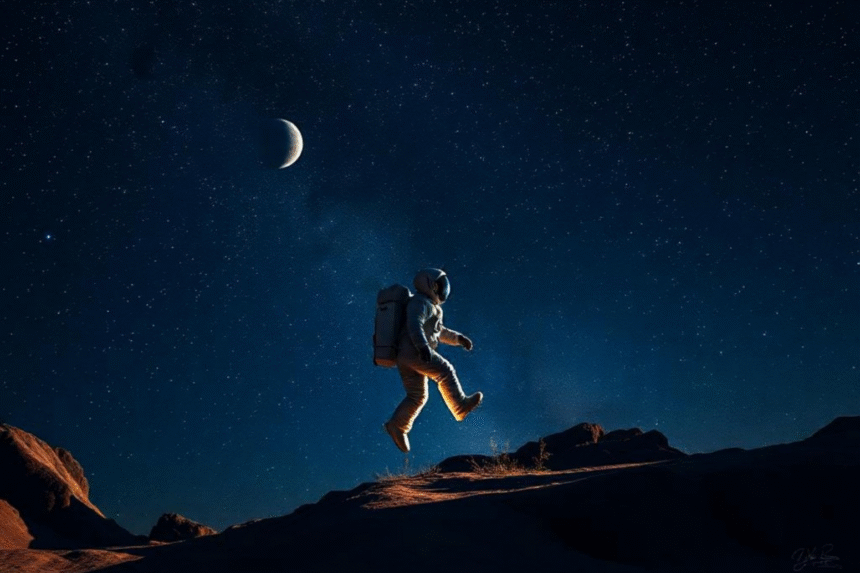
Earth is bright by day, yet photos from space often show a black background behind bright planets and the Sun. That seems odd at first. If sunlight can flood Earth so completely, why does space still look dark? The answer starts with our atmosphere and ends with the history of the universe.
Earth’s Bright Sky Is an Atmospheric Effect
Daytime on Earth isn’t just about sunlight hitting us. It’s also about what happens after that light comes into our atmosphere. Tiny bits in the air spread the sunlight in all directions instead of letting it stay in one straight line. Blue light spreads the most, which is why the sky looks bright and blue instead of black.
This is also why the difference between Earth and the Moon is so striking. The Moon receives strong sunlight but it has almost no atmosphere. Its surface can be brilliantly lit, yet the sky above it remains black even during lunar daytime. Without air to spread light around, space does not glow. It stays dark.
Why Cameras and Human Eyes Often See Black
Images from space can make the darkness look deeper. Cameras are usually set to capture bright subjects such as spacecraft, planets, or the Moon’s surface. Those objects reflect a lot of light, so short exposures keep them sharp and clear. Stars are much dimmer by comparison, so they often disappear from the frame.
The same basic idea applies to vision. In bright conditions, eyes adjust to the strongest light sources. That makes faint stars harder to detect, especially when a sunlit object dominates the scene. With longer exposures, or in darker conditions, star fields appear. So the black background in many space images does not mean stars are absent. It means they were too faint to register under those settings.
The Dark Sky Solves a Famous Cosmic Puzzle
In the nineteenth century, Heinrich Wilhelm Olbers asked a simple but powerful question: if the universe were endless, filled everywhere with stars, and had always existed, why is the night sky not bright like a star’s surface? This became known as Olbers’ Paradox.
Modern astronomy shows that the universe does not meet those conditions. First, it is not infinitely old. It began about 13.8 billion years ago, which means light has had only a limited time to travel. Many stars and galaxies are so distant that their light has not reached Earth yet. The night sky is dark in part because the universe has a horizon set by time.
Second, the universe is expanding. As space stretches, light traveling through it also stretches. Some of that light shifts out of the visible range and into longer wavelengths, especially infrared, which human eyes cannot see. Space is therefore not empty of radiation. It is filled with energy beyond visible light, including radio waves, ultraviolet light, and other forms of emission.
Dust and gas between galaxies can block or absorb some light, and hydrogen clouds are common across space. But this cannot be the main explanation. If dust absorbed all starlight forever, it would warm up and eventually glow as well. The larger point is that stars are not eternal lamps in an ageless universe. They form, evolve and eventually reach the end of their life cycles. Many have not existed long enough to light every direction of the sky.
There is also more in the universe than visible matter. Dark matter cannot be seen directly, yet it shapes galaxies and shows that the cosmos contains major hidden components. That fact does not create the darkness overhead, but it reinforces a broader lesson: what human eyes detect is only a small slice of reality.
So why is there light on Earth but darkness in space? Earth has an atmosphere that scatters sunlight and turns incoming rays into a bright sky. Space lacks that veil. On the largest scale, the universe is young, expanding, and only partly visible to human sight. Darkness is not a failure of light. It is evidence of how the universe is built.