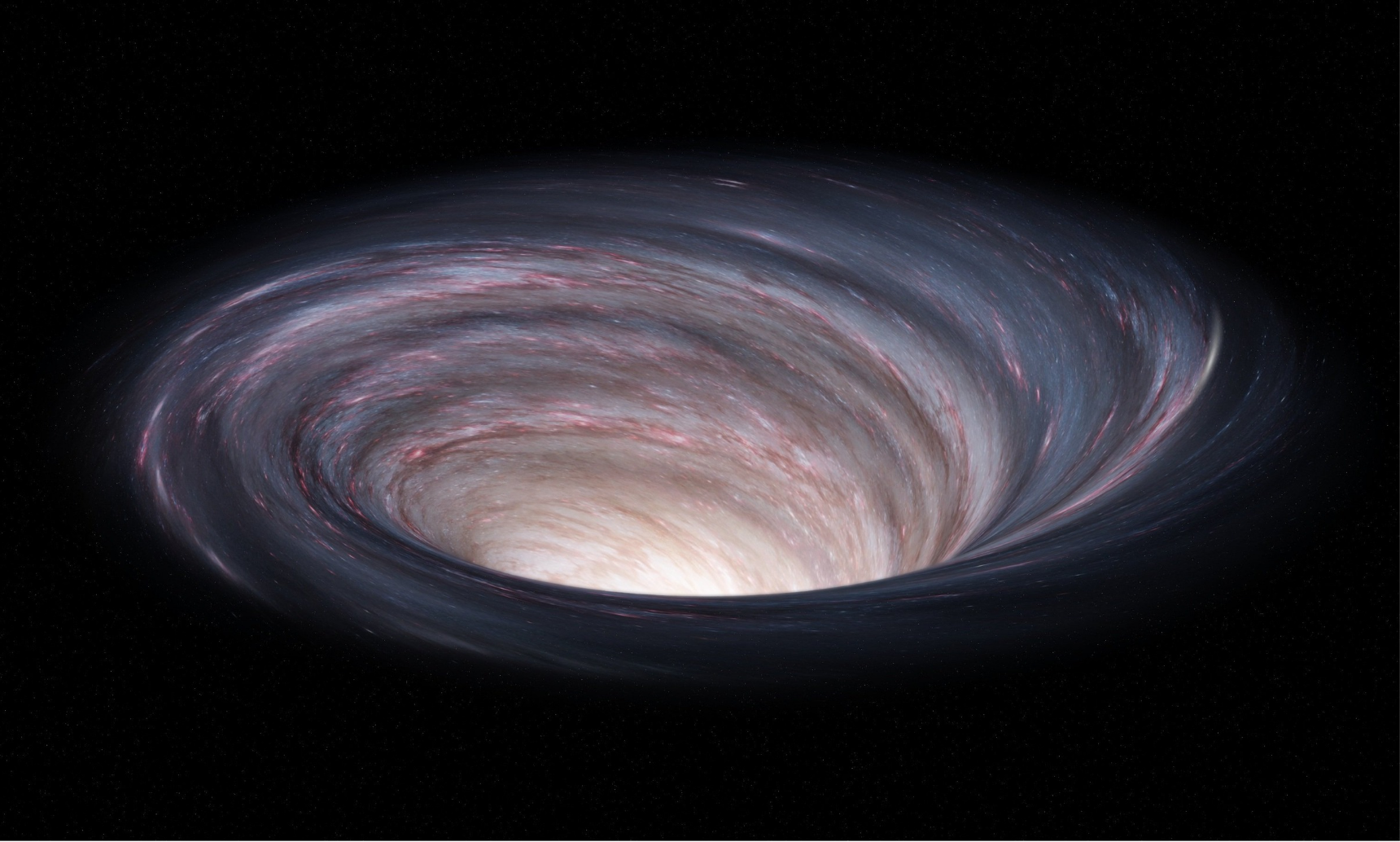
You’re standing on Earth, staring at the night sky. Mars is 140 million miles away. What if you could just walk there? Not in a spaceship. Through a tunnel. A passage through the fabric of reality itself. That’s the dream behind wormholes. And surprisingly, physics doesn’t completely say no.
Space Isn’t What You Think
Here’s something most people get wrong. Space isn’t empty nothingness. It’s a real, flexible thing. Einstein figured this out over a century ago. He showed that space and time are stitched together into one stretchy material called space-time. Massive objects like stars and planets press into it, creating dips and curves. That curving is what we experience as gravity.
Now, if space-time can stretch and curve, a fascinating question follows. Can it fold? Can two faraway points somehow touch? Mathematically, yes. Fold a piece of paper in half. The top and bottom are far apart along the surface but physically touching. Now imagine poking through both layers. You’ve just made a bridge between two distant spots. That bridge is a wormhole.
The equations behind Einstein’s theory genuinely allow this. But equations are generous. They permit lots of things that nature never actually builds.
The Wormholes Scientists Have Dreamed Up
Not all wormholes are created equal. The first version came from Einstein himself, working with physicist Nathan Rosen. Their idea connected black holes to mirrored, flipped universes where time flows backwards. Matter falls into the black hole on our end. On the other end, a “white hole” pushes matter out. Fascinating concept. But not a practical travel plan. The bridge closes instantly and nothing makes it through.
String theory offers a more hopeful option. Some physicists think that in the very early moments after the Big Bang, when the universe was extremely hot and active, many tiny wormholes may have formed. As the universe expanded outward, these tiny tunnels may have stretched across enormous distances.
They could be scattered everywhere right now. Hidden or waiting. Some researchers have even wondered whether the giant black holes sitting at the hearts of galaxies might actually be disguised wormholes. Nobody can confirm it yet, but nobody can rule it out either.
Then there’s the boldest idea. Forget finding one. Make one from scratch.
Building a Wormhole From Scratch
Say we wanted to construct a wormhole. What would it take? First, it needs two openings in different locations. Your living room and the surface of Europa, maybe. Second, there can’t be any point of no return blocking the path. Black holes have event horizons that hold everything inside permanently. A useful wormhole can’t have that. Third, it needs to be wide and stable enough that a person passes through comfortably.
That last part is the real challenge. Gravity works against wormholes. It constantly squeezes them shut like someone closing a zipper. Keeping one open requires something physicists call exotic matter. This isn’t anything found on Earth. It isn’t antimatter either. Exotic matter would have negative mass. Instead of pulling things together like normal gravity, it pushes outward. It resists the closing force.
Does exotic matter exist? Nobody knows for sure. But empty space itself might hold clues. Quantum physics tells us that even a perfect vacuum buzzes with tiny particles flickering in and out of existence. Scientists have already worked with these fluctuations in laboratories. Maybe that’s the starting point for something bigger.
Picture the payoff though. Wormhole stations orbiting Earth. Step into one, step out near a distant star. An entire civilization linked not by years of travel but by doorways.
There’s a question mark hanging over all of this, of course. Many physicists argue that wormholes would challenge the basic rules of cause and effect. They might enable time travel, which creates paradoxes that the universe probably doesn’t permit.
So today, wormholes remain on whiteboards and in research papers. Beautiful math still searching for permission from reality.