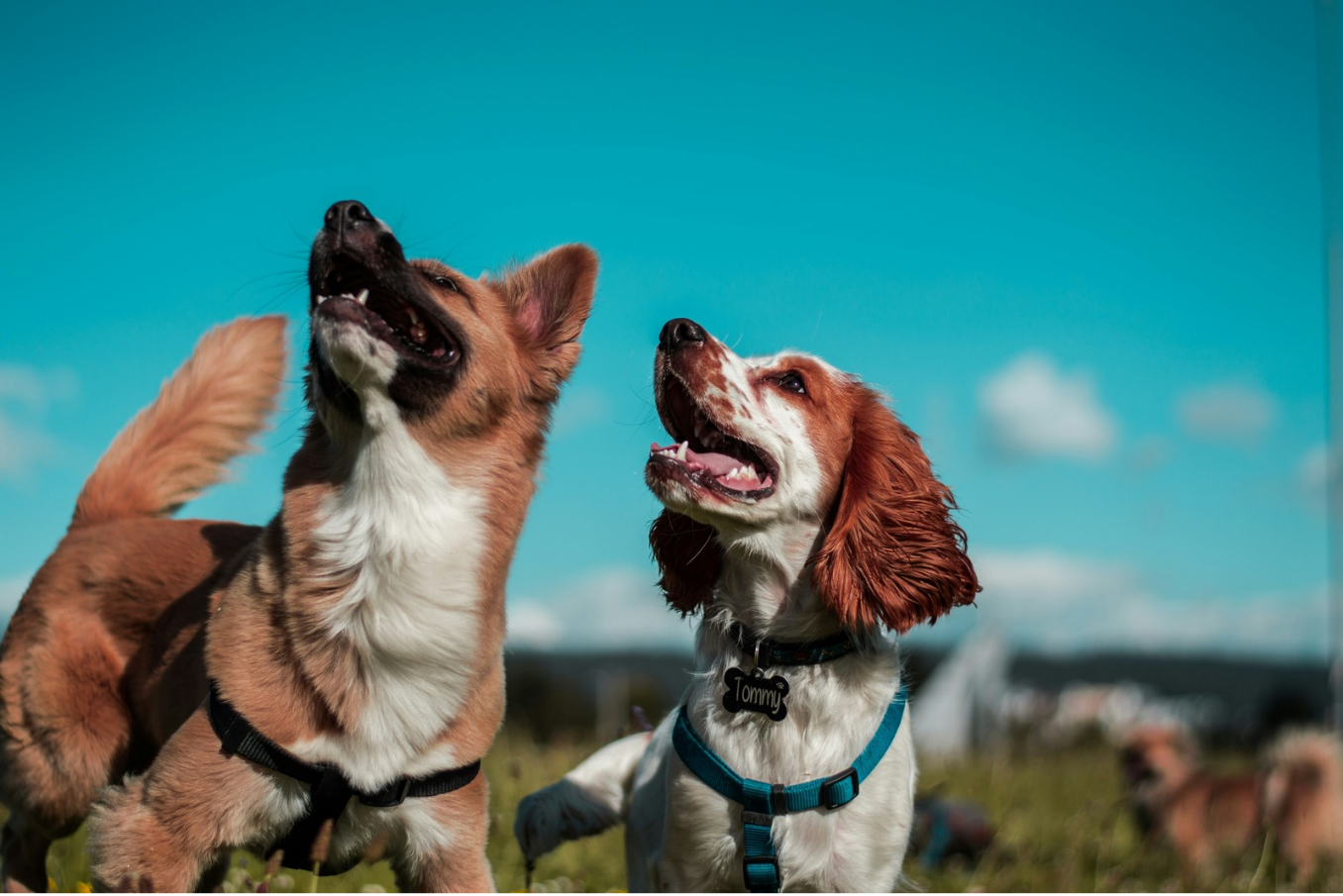
If you spend time around dogs, you notice the obvious signals first: tail position, ear angles, a play bow. What is easier to miss is the tiny “reset” of the eyes.
A growing line of behavioral research suggests that blinking is not just a maintenance habit. It may be one of the small, social cues dogs trade when they feel safe enough to pay attention to each other.
Inside the Parma Study
That idea was tested in a paper led by researcher Chiara Canori at the University of Parma and published in Royal Society Open Science.
The team built a clean, controlled setup: 54 pet dogs sat comfortably and watched short videos of other dogs filmed in three different ways.
In one set, the on-screen dog blinked. In another, it licked its nose. In the third, it simply looked toward the camera with a neutral expression.
The researchers tracked two kinds of reactions.
First was behavior: how often the viewer dog blinked while watching. Second was physiology, using heart rate variability—basically, how flexibly the heartbeat shifts from moment to moment, a widely used indicator of relaxation versus tension in animals and people.
The goal was not to diagnose mood from a single metric, but to see whether certain facial cues reliably nudged a dog’s state.
The clips looked ordinary, and that was the point. No tasks, no treats. The dogs simply watched faces, like they might at a doorway or on a sidewalk.
What Blinks (and Nose Licks) Seem to Mean
The headline result was straightforward: dogs blinked about 16% more when the video dog blinked, compared with the neutral-stare clips. That jump did not show up when dogs watched nose licking. In other words, blinking triggered a matching blink; nose licking did not.
Scientists call this facial mimicry, and it often runs under the radar because it happens fast and without planning.
In humans, blink patterns can sync during conversation, and people sometimes blink right after seeing someone else blink. The canine data point in the same direction: a blink may be a subtle “I’m with you” signal rather than an accident.
Why would a blink matter socially?
One practical explanation is that blinking briefly breaks eye contact, which can soften an interaction.
Direct staring can be intense for many species, including dogs. A blink may function like a tiny pause that says, “No pressure,” keeping the moment friendly and readable.
Nose-licking videos told a different story.
Dogs did not copy the lick, and they showed more visible sclera, which researchers often link with uncertainty. The lick may signal anticipation or mild frustration rather than an affiliative cue.
On the physiology side, the heart measures did not swing dramatically across the three video types. Overall, the dogs stayed steady, and there was even a small drift toward relaxation after the viewing period.
That supports a simple takeaway: observing facial cues, at least in this format, was not agitating or upsetting for most dogs.
What This Could Change—and What We Still Don’t Know
This blink effect also fits a broader animal story. Studies on non-human primates, such as macaques, show that blink timing can shift with social context, hinting that eye behavior has deep evolutionary roots.
Meanwhile, cats and horses are known for “soft eye” signals, including slow blinking, that often correlate with trust and calm intentions. Dogs may be doing their own version, faster and easier to miss.
For trainers, shelter staff, and anyone assessing canine comfort, the work is a reminder to look beyond the loud signals.
Blink frequency is not a magic gauge, and context always matters—dogs can blink when relaxed, curious, or mildly uneasy. Still, if blinking is partly contagious, it may help explain why calm dogs can “settle” a room and why tense encounters sometimes stay tense.
The biggest limitation is also obvious: the dogs were watching videos, not meeting another dog face to face. Real interactions include scent, distance changes, and shared timing in a way a screen cannot reproduce.
Canori and colleagues point to next steps such as tracking blink sequences during play, measuring how blinks cluster in groups, and testing related micro-signals like yawns and small eye movements.
For now, the conclusion is meaningful. A blink is not necessarily random. In the right moment, it can work like a quiet social handshake, helping dogs coordinate and keep interactions smooth.
Sources
https://pmc.ncbi.nlm.nih.gov/articles/PMC4531238
https://www.pnas.org/doi/10.1073/pnas.1214804110
https://pmc.ncbi.nlm.nih.gov/articles/PMC4687595
https://www.nature.com/articles/s41598-020-73426-0
https://www.sciencedirect.com/science/article/abs/pii/S0031938418308576