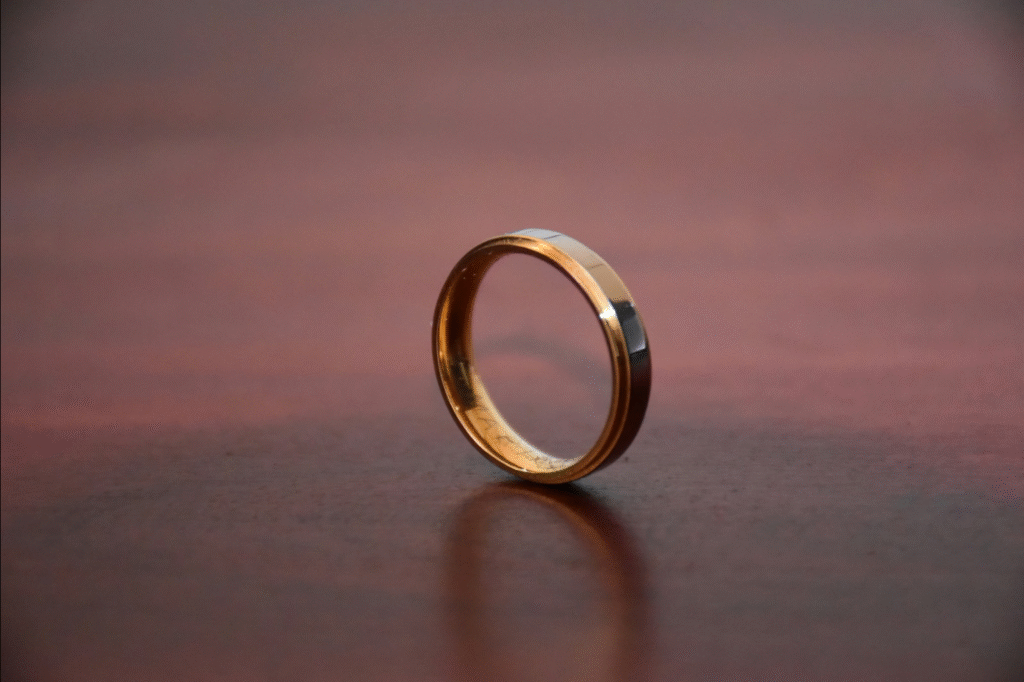
For nearly half a century, Florene Bush believed her wedding ring was gone forever.
In the early 1970s, Florene was working in the garden outside her home in Leoma, Tennessee, when her gold wedding band slipped from her finger. She did not notice it immediately. By the time she realized the ring was missing, there was no obvious sign of where it had fallen.
So she looked for the ring in the dirt as carefully as she could. But it was never revealed. She looked out at the garden wondering where she had been working, but the little gold band was gone without a trace. Eventually, she had no choice but to accept that it might never be found.
Even after the years passed, however, Florene did not forget about it.
Her son, Frank Bush, later said that she continued to mention the ring from time to time. It was more than a piece of jewelry. It was her wedding ring, a tiny reminder of her marriage and the life she had made with her family. Although she had long since stopped expecting its return, the memory of the ring remained with her.
By 2019, Florene was 94 years old and living in a nursing home. The ring had been missing for almost fifty years. The garden where it had disappeared had changed, and the passage of time had made the chances of finding it seem almost nonexistent. Most people would have assumed the ring was buried too deeply, moved by years of gardening, or lost forever beneath the soil.
Then, a chance conversation changed everything.
A Conversation That Sparked a Search
Wesley White was visiting his mother at the same nursing home where Florene lived. White was retired and enjoyed metal detecting in his spare time. He often searched parks, yards and open areas for old coins and other buried objects.
During one visit, White happened to overhear Florene talking about her lost wedding band. He learned that she had misplaced it while gardening decades earlier. The story stayed with him.
White was used to finding ordinary objects while metal detecting. Many signals turned out to be nails, bottle caps, scraps of metal, or other items with little value. But this search would be different. If he could locate Florene’s ring, he would not only be recovering an old object. He would be returning a meaningful part of her past.
He approached Florene’s family and offered to search the area around her former home. Frank was understandably doubtful. After so many years, no one knew exactly where the ring had fallen. The garden had changed, and the soil had likely been disturbed many times.
Still, Frank agreed to let White try. There seemed to be little risk in making the attempt. The ring was already considered lost, and even a failed search could not make the situation worse.
White then asked his friend Jeff Howell to join him. Together, the two men went to the property and began examining the ground with their metal detectors.
Ninety Minutes Beneath the Soil
Searching for a small ring in a large garden requires patience. White and Howell slowly moved their detectors back and forth across the area, carefully listening for a promising signal. They had only a general idea of where Florene might have been working when the ring disappeared.
For about an hour and a half, the search produced nothing significant. Every signal had to be investigated, even though most were likely to be ordinary pieces of buried metal. Metal detecting can be a slow process, especially when searching ground that has been disturbed over many years.
Then, after approximately ninety minutes, the detector gave them a strong signal.
The men began digging. Their tools moved through the soil and about five inches below the surface, they uncovered a gold band.
At first, they could hardly believe what they were seeing. The ring had been underground for close to five decades, yet it was still in remarkably good condition. It had no major scratches or obvious damage. After a quick cleaning, the band looked much as it might have decades earlier.
White and Howell immediately knew that the discovery was special. They had not found a random piece of jewelry; they had found something that belonged to a woman who had spent most of her adult life wondering where it had gone.
An Emotional Reunion
When White and Howell arrived with the news, Frank remembered them appearing at the door and announcing that they had found the ring.
Florene was stunned. She had spoken about the wedding band for years, but she had never truly expected to see it again. The possibility that it might be recovered had seemed more like a dream than a realistic hope.
When the ring was placed in her hands, that dream became real. After nearly fifty years, Florene was able to slide her wedding band back onto her finger.
It was felt with great passion. The ring represented her marriage. Her memories. A chapter of her life that had never quite gone away, even if the ring itself was gone. It restored to her something she had lacked in silence for decades.
It was a meaningful recovery for Frank too. The ring was more than just a precious possession of his mother’s to him, it was a family heirloom that he wanted to pass down thru the generations. The band now carried an extraordinary story: it had been lost in a garden, buried for nearly fifty years, and recovered because a stranger happened to hear about it.
More Than a Piece of Jewelry
Florene’s story shows why lost-ring searches matter so much to the people involved. A wedding ring may be small but its emotional value can be enormous. It often represents a promise, a relationship, and decades of shared memories.
Across the country, metal-detecting hobbyists regularly help people search for lost jewelry in yards, parks, beaches, and public spaces. Some belong to groups such as TheRingFinders, a network that connects people who have lost valuable or sentimental items with volunteer detectorists willing to help locate them.
Many searches end without success. Even experienced detectorists may spend hours finding nothing more than scraps of metal. But when a search does succeed, the reward is often far greater than the object’s financial value.
In Florene’s case, the recovery was especially remarkable because of the time involved. Most lost rings are found within days, months, or perhaps a few years. Finding one after almost fifty years is unusual. The fact that the search began with a conversation in a nursing home makes the story even more memorable.
For White and Howell, the search may have begun with a simple act of kindness. For the Bush family it was a moment they would never forget.
A ring that had seemed lost forever was finally home again and instead of disappearing into the past it has a future as a family heirloom.
Sources
Metal detectors find wedding band that was missing for nearly 50 years
Metal Detector Finds Wedding Ring Missing for Almost 50 Years
Man Finds 94-Year-Old Woman’s Wedding Ring Using Metal Detector
Tennessee man using a metal detector finds wedding ring lost in the 1970s
Man finds 94-year-old woman’s wedding ring nearly 50 years after she lost it
Armed with his metal detector, B.C. resident reunites lost jewelry with their owners