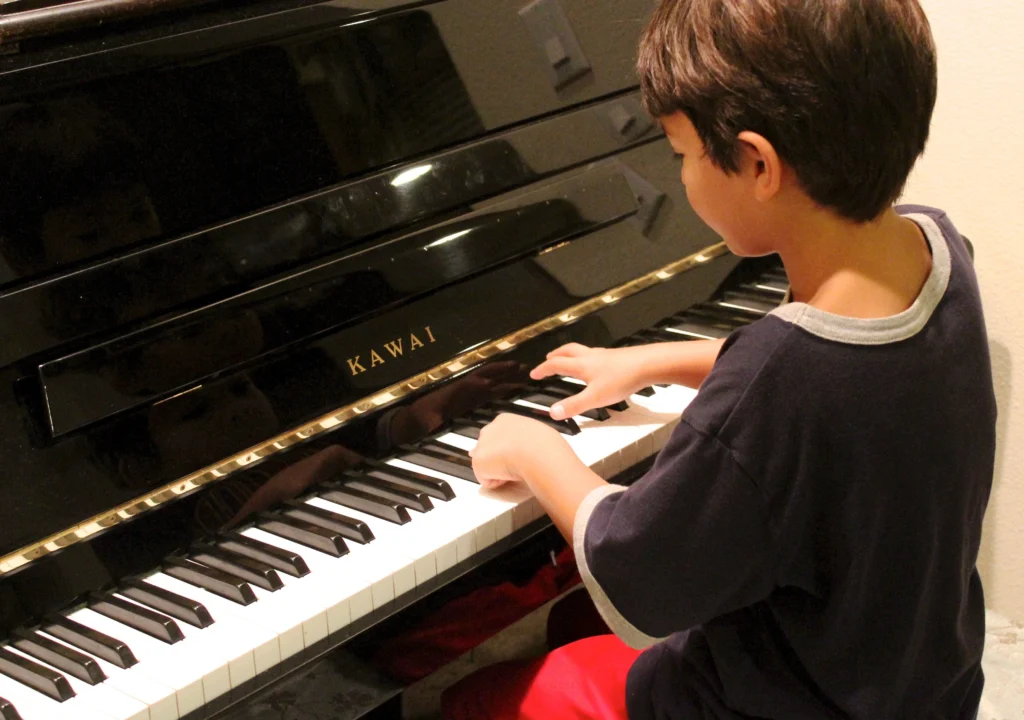
Learning to play an instrument is a long and arduous process, filled with scales, calluses, and endless hours of practice. But scientists have uncovered that all this training has some side benefits that have nothing to do with music.
Musical training has been found to alter the brain, improve memory, and even help at work later in life, in ways that most would never expect.
The Brain Physically Changes With Practice
To play an instrument is to challenge the brain in ways few activities do. The musician must be able to read the notes and move their fingers at the same time while also listening closely to the sounds coming out of their instrument.
This is neuroplasticity, which is the brain’s ability to change and adapt based on experiences, being put into motion. Scientists who have compared the brains of trained performers with those who have never trained have found tangible differences in their brains.
The changes seen in the brain are associated with improved hearing, motor skills, and coordination, and these changes have been found to become more apparent with greater amounts of musical training, according to scientific reviews.
Neurobiologist Nina Kraus of Northwestern University’s Auditory Neuroscience Lab has studied the effects of sound on the brain for years and spends her time speaking to others about the information.
“The sounds of our lives change our brain,” she explained to the audience at a research conference while presenting her data.
Kraus and her colleagues have found that they can identify musicians based on how precisely they process sound, and that this precision does not remain confined to the realm of music, but rather influences the way a person might process speech as well, she has found.
The only problem is that listening to music alone does not appear to cause these changes in the brain to the same extent as making music does. While passive listeners might enjoy what they hear, it does not have the same effect on the brain that actively playing an instrument does.
Memory, Attention, and Language Skills Improve
The effects of musical training on the brain do not remain confined to just the auditory senses and motor control, but rather these skills have been found to cross over into other areas as well, including memory.
A large analysis of studies concerning memory found that trained musicians were able to outperform their peers on various short-term memory and working memory tasks, with the largest gaps being seen in the tests that specifically concerned musical sounds, but improvements were still seen on tests in other areas, including verbal memory, according to research summarized by Nature Index.
Children who study music have been found to have better verbal memory, improved pronunciation in foreign languages, and better reading skills than their non-trained peers, according to a review on the cognitive benefits of musical training.
The same review also mentioned that musical training in childhood can be used to predict future academic performance and IQ scores in young adults, although these associations do not by themselves establish that musical training causes those outcomes.
Timing is also important in musical training, as far as the age at which a musician begins their training is concerned. The earlier a person begins training, the greater the benefits they may see, but that is not always the case.
The desire to learn, the reward in practicing, and the environment in which the training occurs can all affect how a child’s brain is altered by musical training, according to the review.
Memory is not the only thing that improves with musical training; attention and focus also see improvements.
Musicians have been found to have better executive function, which is the set of cognitive skills that includes planning, focus, and the ability to ignore distractions, than non-musicians, which is also incredibly useful outside the realm of music.
All of these skills are ones that we use in our everyday lives, whether they’re needed to complete a task at the office or to manage a household.
The Advantage Does Not Fade With Age
As people get older, cognitive decline can begin, and some of the mental abilities that allowed them to excel in youth can slow down. But musical training has been associated with benefits for the aging brain as well.
Older adults who practice instruments have shown differences in processing speed, attention, memory, cognitive flexibility, and spatial awareness, according to a review on the differences in the brains of older musicians.
Researchers in Germany and Switzerland set up a study to examine this, and began the long process of seeing what changes they could find in older adults. The adults in the study were broken up into two different groups.
One group learned to play the piano, and the other participated in music appreciation and listening sessions. The researchers planned to measure the effects on the participants over 18 months.
The researchers predicted that the piano group would see the most improvement in their executive functioning, working memory, processing speed, and fine motor skills, according to the protocol of the study published in BMC Geriatrics.
Hearing also benefits from musical training, and the evidence is stronger than the original wording suggests.
When examining the results of 31 individual studies that looked at how hearing was affected by musical training, researchers found a significant overall advantage for musicians in understanding speech in noisy environments compared with non-musicians.
However, the researchers noted that the results could reflect either effects of music training or pre-existing auditory advantages that encourage people to become musicians, meaning the findings do not by themselves prove that musical training caused the difference.
Employers Are Noticing the Difference
All of these benefits that arise from musical training can be valuable to people all over the world, but it is the business world that has taken notice of these gains.
In a survey conducted for the Royal College of Music, business leaders were asked to rate subjects across seven workplace competency areas, including communication, creativity and innovation, teamwork and collaboration, problem-solving, adaptability and flexibility, leadership, and time management.
Music was rated the highest across all seven areas by these business leaders, and almost all of the business leaders mentioned that they personally enjoyed music, while 90% stated that music helped them concentrate at work.
Other surveys of working professionals support some of these claims, as those who have degrees in music and go on to work in different fields show transferable skills, particularly in their teamwork abilities.
Playing in a group, particularly in chamber ensembles, has been reported to teach musicians to listen closely to each other, to react quickly, and to recover from mistakes, all of which can be beneficial in the workplace.
Musicians surveyed about their careers also have an interesting outlook, in that they tend to be more accepting of failure than the general population. Missing notes in a practice room or during a show is an everyday part of life for someone studying or working as a musician, and this has been reported to teach these people to be more comfortable with failure.
This same philosophy has been found to contribute to the work ethic that many musically trained people develop, as they must commit to years of practicing to get ready for a show, or to perfect their craft if they decide to make a living as a solo performer.
As such, co-workers have reported that their musically trained co-workers demonstrate strong professional values, a strong work ethic, willingness to learn, and the ability to take initiative.
A Skill That Pays Off in Unexpected Places
None of this is to say that a person must be a trained, professional musician to receive the benefits of musical training, as several years of practicing an instrument can still be associated with long-lasting effects on the brain and skills of an individual.
The research on these benefits is still developing, and not all of the evidence is completely conclusive, but the overall research suggests that musical training has advantages that extend well beyond the realm of music, including effects on cognition, aging, hearing, and workplace skills.
Sources
Nature Index — Cognitive Benefits of Musical Training
Dementia & Neuropsychologia (SciELO) — Musical Training, Neuroplasticity and Cognition
Brain Sciences (MDPI) — Musical Training and Brain Volume in Older Adults
BMC Geriatrics — Train the Brain with Music (TBM) Study Protocol
ScienceDaily — How Music, Language Shape the Brain (Nina Kraus / Falling Walls Conference)
Northwestern University — Nina Kraus, Auditory Neuroscience Lab
Buffalo FOM — Are Recruiters in Tune? An Education in Music Makes You a Better Employee