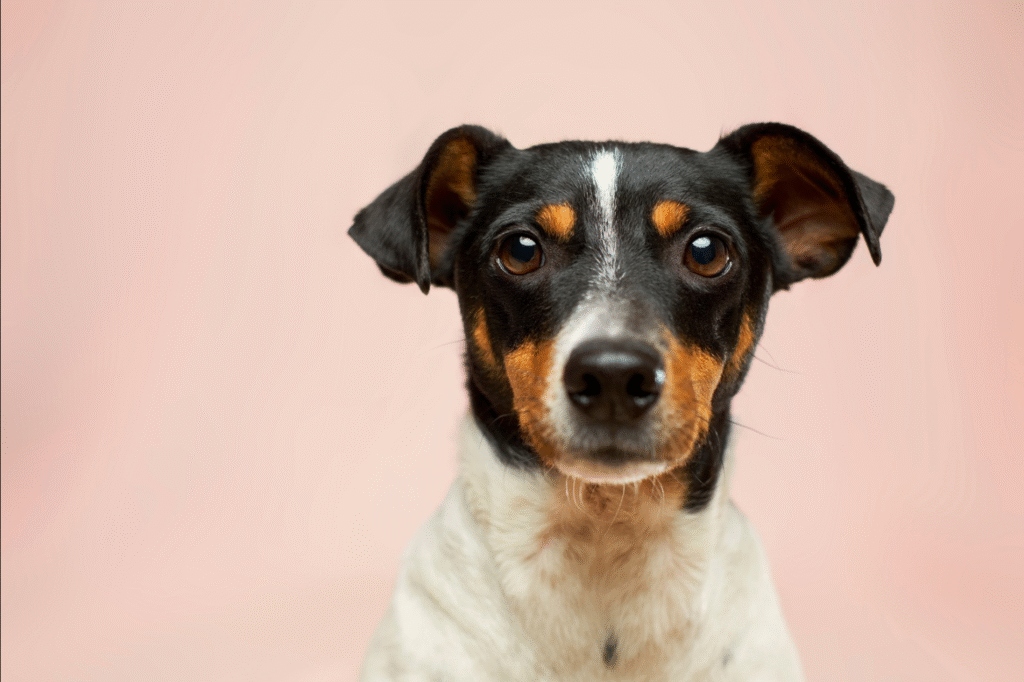
Dogs may use their faces for communication purposes. A 2017 study found that dogs produced more facial movements when facing a person who looked at them than when the person could not see them.
The dogs also exhibited more facial movements with human attention than with food as a motivator. The researchers concluded that dogs are sensitive to a human’s attentional state, meaning their expressions are not purely instinctive.
What Researchers Tested
The study, published in the journal Scientific Reports, was conducted among 24 family dogs recruited through a database at the Max Planck Institute for Evolutionary Anthropology in Leipzig, Germany.
The subjects came from different breed backgrounds and ranged in age from one to twelve years. Each dog experienced a test in which a person sometimes faced the dog and sometimes turned away, while also varying whether food was presented or kept out of sight.
As such, the researchers could distinguish between responses triggered by a social reinforcer (the person’s attention) and a non-social one (food): if food motivated the dogs, they would react the same way regardless of whether they could see the person, but if attention drove their behavior, their reactions would differ.
Throughout the experiment, the observer remained silent and still, and did not seek eye contact with the dog even while facing it.
Researchers filmed each dog’s face and coded the movements with DogFACS, a system that works much like the Facial Action Coding System used for human expressions.
The test did not harm the dogs; they were treated as ordinary pets and simply observed under a few set conditions.
The researchers’ conclusions were explicit: dogs produced significantly more facial movements when the person was attentive than when she was not, while food, a non-social but stimulating reward, did not have a comparable effect on their behavior.
The Expressions Dogs Used
The inner eyebrow raise and the tongue-out expression were the two canine facial movements that stood out when a human faced the dog.
The eyebrow movement, labelled Action Unit 101 in the study, is associated with puppy-dog eyes, a trait linked to youthfulness.
Raising the inner eyebrows widens the visible eye area, a feature humans tend to find appealing; dogs have a dedicated facial muscle for this movement that wolves lack, which may have given expressive dogs an edge during domestication.
The researchers did not indicate dogs used this expression for one particular reason every time; a similar movement can trigger diverse reactions among different species, or even within the same species. Still, the eyebrow raise occurred significantly more often when a human faced the dog.
Furthermore, the dogs responded to attention by showing their tongues. The researchers noted this movement could be linked to mild stress, since it resembles licking behavior, or to panting used for temperature regulation; in general descriptions of dog behavior, it is sometimes instead read as a sign of attentiveness.
Because the movement lacks one settled meaning, context remains crucial when studying canine expressions.
One of the study’s researchers, Dr. Juliane Kaminski, has explained that the study confirms dogs produce facial expressions in response to their audience’s attention rather than simply because they are excited, adding that “seeing food treats did not have the same effect.”
This demonstrates the study’s main point without overreaching. It also suggests dogs do not think exactly like people, so researchers are cautious about assigning human emotions to their behavior.
Instead, the researchers identified patterns that held true across the dogs tested.
It is possible the dogs learned to associate certain human expressions with rewards and that something similar happens with their own, though the study does not settle on one explanation; it does show that a human’s attention affects canine facial movements.
Why Eye Contact Is Important
The study’s results align with earlier findings on a dog’s ability to recognize human attentiveness.
A 2004 study tested whether dogs could read a human’s head orientation, body posture, and whether their eyes were visible, using tasks such as fetching objects on command and begging for food.
Dogs adjusted their behavior according to these cues, helping them determine whether a human was watching.
Other researchers have explored dogs’ eye-contact abilities from different angles. A team from the University of Helsinki discovered that a dog tends to look first at the eyes of a human or another dog, and examines the eye region longer than the nose or mouth.
But the expression shown can shift where a dog looks: viewing a threatening dog face, dogs directed more attention toward the mouth, showing gaze pattern depends on both the expression and the features dogs use to detect threat.
This proves useful in real life, since dogs often need to know whether a human is paying attention before responding to a command.
A dog may check a person’s face to confirm a signal applies to them personally, relying on similar cues, along with body posture and tone of voice, to read a person’s mood and maintain social bonds.
The facial expression study in this respect suggests that dogs might be using their own expressions to communicate information to humans.
Researchers referred to such expressions as “potentially active attempts to communicate with others,” rather than involuntary displays of emotion.
This does not imply dogs think the way humans do; it only suggests their expressions may hold more meaning than assumed. A dog might raise its eyebrows to draw attention when a human is looking at it, though the exact intent behind any single instance cannot be confirmed.
What Owners Can Learn
For dog owners, the research is a reminder not to focus on facial cues alone; the rest of a dog’s body and the sounds it makes matter too.
A 2023 review of the methods used to study emotion perception in dogs pointed out that most research in this area has concentrated narrowly on the face often leaving the body out of the picture even though it carries meaningful information too.
Even within the face, there is no universal meaning behind any single expression: puppy-dog eyes may indicate friendly intentions in one context but their meaning still depends on the situation.
Furthermore, owners should not assume every expressive movement relates to food. As the study demonstrated, seeing food did not increase a dog’s facial movements nearly as much as human attention did.
This does not mean dogs are uninterested in food or never use expressions to signal a desire for it; it shows attention, not appetite, is the stronger trigger for their expressiveness.
As such, a calm dog that looks at a person and raises its eyebrows is likely trying to engage. By contrast, another dog might make the same expression in a different context to signal reluctance to participate.
Reading these details in context is crucial for handling dogs well, since calm, attentive communication supports a good relationship between owner and pet.
This adds to a broader body of work on dogs’ social skills; scholars have shown dogs can interpret pointing gestures, posture, and behavior to identify what a person intends.
More research is needed to determine exactly how dogs communicate through their faces, but current evidence shows these expressions extend beyond automatic reactions, and that dogs can adjust them to engage socially under certain circumstances.
Sources
Human attention affects facial expressions in domestic dogs
PubMed record and abstract for the 2017 study
University of Helsinki: Dogs distinguish emotions behind facial expressions
Visual perception of emotion cues in dogs: a critical review of methodologies
University of Portsmouth press release: Dogs are more expressive when someone is looking