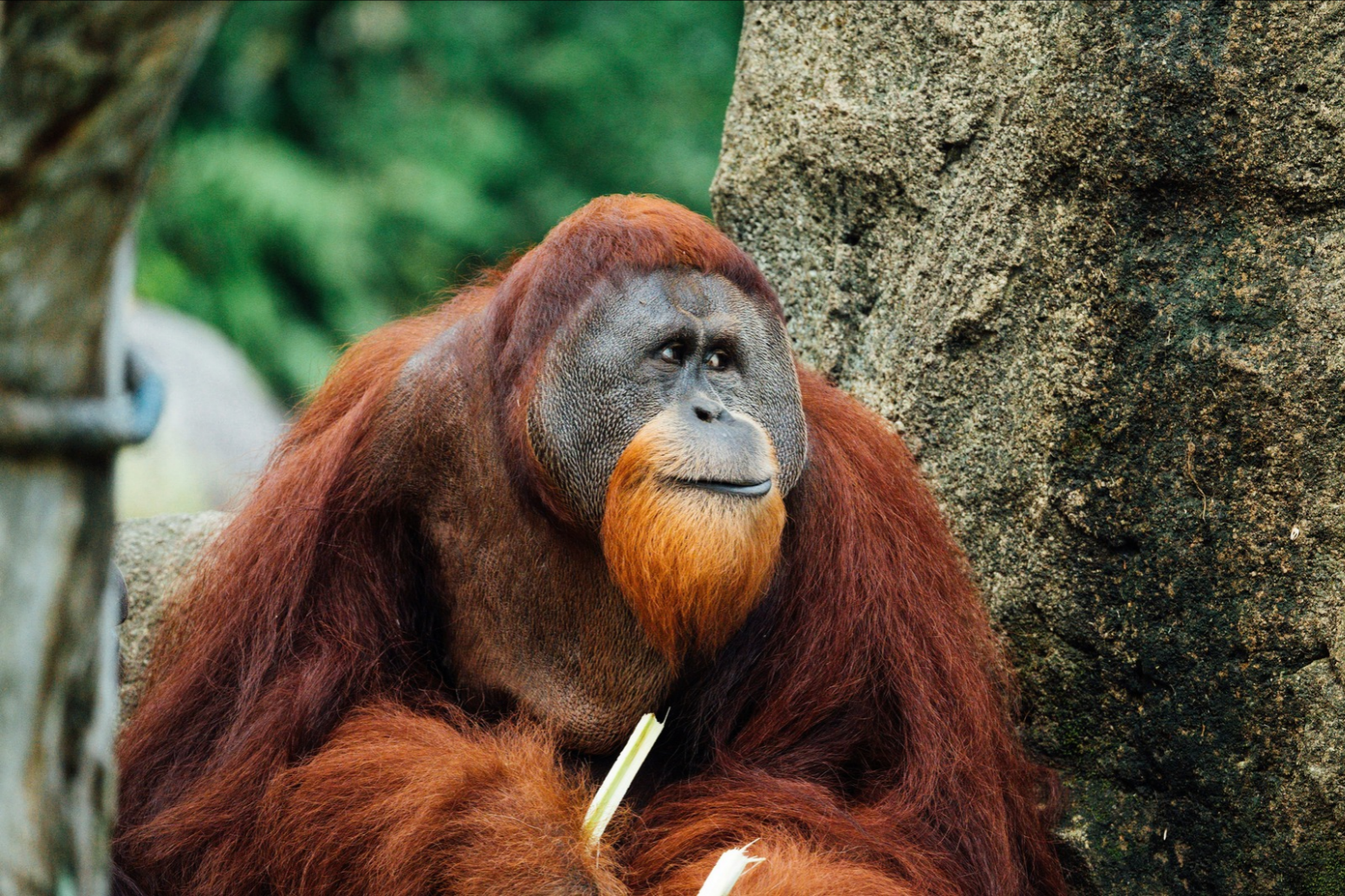
Orangutans chose food that was tied to the sound of laughter, a study published in October 2026 found. The research appeared in the journal Biology Letters. Apes in the study were more likely to pick treats linked to the sound of peers having fun, which suggests that emotions can influence learning.
What Scientists Knew About Ape Laughter
Laughter is not uniquely human. Great apes produce similar vocalizations during play and a study published in June 2025 in Scientific Reports found that bonobos were more likely to approach ambiguous stimuli after hearing recordings of their own kind laughing. The research was conducted by a team that included Sasha Winkler and Erica Cartmill.
Four bonobos at the Ape Cognition and Conservation Initiative in Des Moines, Iowa, were trained to approach a black box containing food and avoid a white box that was always empty.
Researchers then introduced gray boxes that offered an uncertain outcome. After hearing recordings of bonobo laughter the animals were more likely to approach these boxes in search of a reward. Winkler described the effect as the “rose-colored glasses effect.”
In June 2026, another study published in Communications Biology identified laughter-like vocalizations in 13 captive primates, including gorillas, orangutans, chimpanzees and bonobos.
The findings suggested that humans and great apes inherited similar laughter-like vocalizations from a common ancestor that lived around 15 million years ago.
“We have been laughing in a similar way for 15 million years,” said study author Chiara De Gregorio, a primatologist at the University of Warwick in England, speaking to The Associated Press.
However, scientists had yet to establish whether hearing another ape’s laughter could change how an animal valued and remembered a reward.
How the Orangutan Experiment Worked
The new study was led by Daan Laméris, a postdoctoral researcher at Indiana University, and conducted in the lab of Erica Cartmill, a professor of animal behavior, anthropology and cognitive science at IU Bloomington.
The researchers investigated whether hearing laughter while learning about a reward would make orangutans value that reward more highly.
Six orangutans participated in the research. One lived at the Indianapolis Zoo, while the other five lived at ZOO Planckendael in Mechelen, Belgium, where Laméris conducted most of the experiment. According to the bioRxiv preprint, participation was voluntary, and every session used positive reinforcement.
The researchers adapted an Affective Bias Test, a method commonly used with laboratory rodents. In a preliminary test, one material was paired with three treats and another with one. Four of the six orangutans preferred the material associated with more food, indicating that the test could detect differences in reward value.
The main experiment lasted five days. The orangutans searched bowls containing materials such as wood chips, paper towels or yarn that concealed food rewards.
On days one and three, one material contained food while the other did not. On days two and four the previously unrewarded material was presented alongside a new material that concealed food.
On the fifth day, the researchers presented two materials that had both previously contained food. This allowed them to assess whether the animals preferred one material over the other even though both offered the same reward.
Before the tests, researchers played recordings of orangutans playing and laughing in association with one material.
The other material was associated with a control recording of wind. Each laughter recording lasted five minutes and featured young orangutans unfamiliar to the listeners. The control recording’s volume matched that of the laughter.
The researchers also switched which sounds were associated with each material across participants to prevent any particular material from having a consistent advantage.
What the Orangutans Chose
On the fifth day, both materials concealed food, meaning the orangutans were choosing between equally rewarding options. The difference was their previous association with laughter or wind sounds.
According to The Guardian, four of the six orangutans showed a clear preference for the material associated with laughter. The overall results also indicated a tendency to favor that option.
The animals learned the reward associations at similar rates, suggesting that laughter did not make them learn faster. Instead, it appeared to influence how much they valued what they had learned. They also did not laugh in response to the recordings, suggesting that their preference was not simply a result of imitating the sounds.
Cartmill suggested that hearing laughter might have put the animals in a positive mood when they associated a particular material with food.
Laméris said the findings were surprising because orangutans are considered the least social of the great apes.
Dr. Adriano Lameira, a primatologist and evolutionary psychologist at the University of Warwick who was not involved in the research, also found the results intriguing. He compared the animals’ choices to a person wanting what others appear to enjoy.
What the Findings Could Mean for Learning
The research formed part of a larger project examining the role of positive emotions, particularly joy, in animals. Cartmill said animal studies have often focused on negative emotions, such as fear and grief, and she wanted to investigate positive experiences as well.
She compared the findings with the way people may prefer their grandmother’s pancakes, not necessarily because they are objectively better than other pancakes, but because they are associated with pleasant memories. Such associations can influence how people value an experience.
Cartmill also suggested that mood might affect how students value information. Students could learn at similar rates regardless of their emotional state, yet place greater value on information learned while feeling positive.
Conversely, anxiety during math lessons could contribute to a student developing a lasting dislike of the subject.
The study involved only six orangutans, a limitation common in research with great apes. Although the researchers used statistical methods to analyze the results, the small sample means further research is needed to establish how broadly the findings apply.
Overall, the results suggest that positive emotional cues may influence how orangutans value rewards and retain associations, offering a way to investigate the relationship between emotion and cognition beyond humans.
Sources
Orangutans prefer food associated with sounds of laughter, study suggests
Hearing laughter may cause orangutans to value rewards more
Play vocalizations induce affective bias in reward learning and memory in orangutans
Play vocalizations induce affective bias in reward learning and memory in orangutans
Bonobos that hear laughter are more likely to try to get rewards