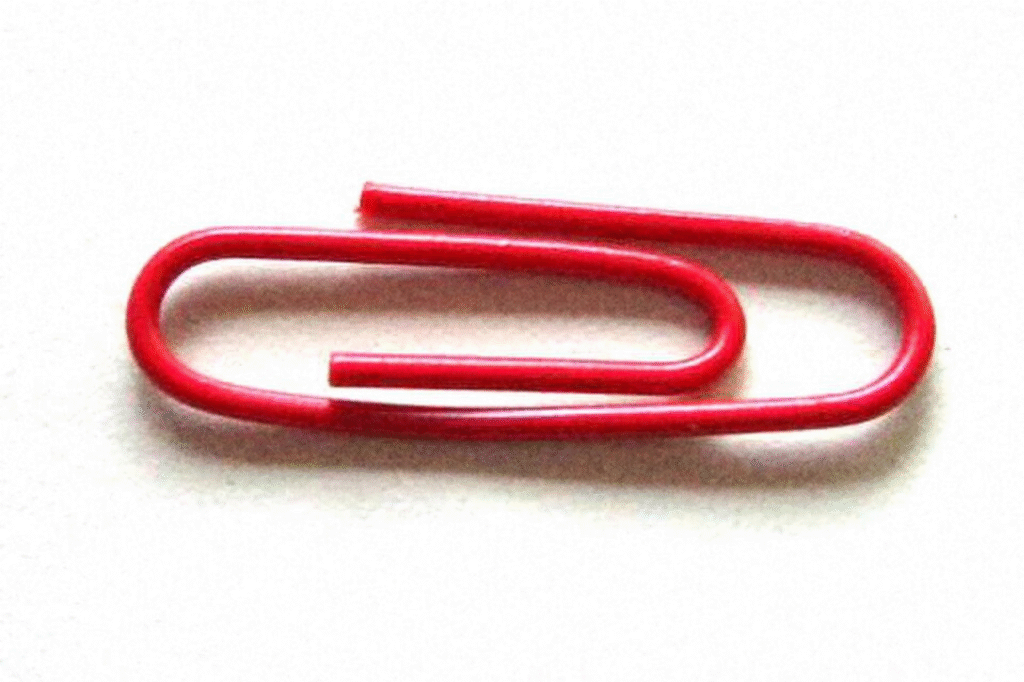
In the month of July 2005, somewhere in Montreal, a young man made a challenge to himself. He got an ordinary paper clip and decided to trade it for something more expensive. As a result, within one year and fourteen trades, he acquired a house.
A Small Item With a Big Idea
Kyle MacDonald was twenty-six and lived with his girlfriend, Dominique Dupuis, in Montreal. They had two roommates, and he paid about three hundred dollars a month for his share of the rent by working odd jobs and helping at various trade shows. He loved traveling, geography, and writing, but he did not have enough money to afford a house on his own.
MacDonald came up with the idea for the paper clip challenge after playing an old childhood game called “Bigger, Better” and thinking about how far he could take the idea. In this game, one person thinks of an object and then another person tries to think of something “bigger and better” in terms of trade.
MacDonald thought of starting with a paper clip and going from there.
He posted the item for trade on the barter section of Craigslist, a popular website for classified ads. He wrote that he was looking for something of greater value in return, and added a lighthearted postscript revealing his ultimate ambition: to keep “trading up” until he ended up with a house — or an island, or a house on an island.
MacDonald’s barter challenge progressed unexpectedly fast. While in Vancouver, two women traded a fish-shaped pen for his paper clip. MacDonald then traded the fish pen for a small doorknob carved with a smiling face, made by the son of a Seattle artist named Annie Robbins.
MacDonald kept a web log of all the trades, posting pictures of the items and the stories of their owners so that other barter enthusiasts could follow along online and get involved in the challenge.
Even at this early stage, he was overwhelmed by the response. He once admitted, “It’s totally overwhelming, I’m not going to lie,” but he continued with the challenge.
Going Bigger and Better
The smiling doorknob opened the floodgates to a prolific series of trades, with each item superior to the one before it. The first significant trade was a camping stove, acquired from a man named Shawn Sparks, who was relocating from Massachusetts to Virginia and had no use for two stoves.
Sparks needed a doorknob for his stovetop espresso maker, so the deal was completed. MacDonald continued his search for more valuable items and traded the camping stove for a generator from a Marine sergeant stationed at Camp Pendleton in California.
MacDonald’s luck took a turn for the worse when the generator was temporarily confiscated by the New York City Fire Department, which was concerned that it was leaking fuel. Undeterred, MacDonald tracked it down at a firehouse in lower Manhattan and claimed it back.
He then traded the generator with a young man in Queens, New York, for an “instant party,” which consisted of an empty party keg, a neon beverage sign, and a promise to fill it.
The “instant party” set was handed over to a Quebec radio and comedy personality, Michel Barrette, in exchange for a Ski-Doo snowmobile.
The snowmobile trade led to another surprise. During an interview with the Canadian Broadcasting Corporation, in which MacDonald was asked if there was any place he would not go to make a trade, he named the small community of Yahk, located in British Columbia.
A snowmobiling magazine based near Yahk, having heard the exchange, offered him an all-expenses-paid trip for two to Yahk in exchange for the snowmobile itself.
Rather than use the trip himself, MacDonald put the spare seat up for trade, and a supply-company manager named Bruno Taillefer arranged for his employer to give MacDonald a delivery van in exchange for it.
MacDonald then passed the van on to a Toronto-based musician, who provided him with recording studio time and a contract in exchange for it.
This is when it dawned on him that the challenge had gone “way bigger and better,” as he put it, and now involved half the continent.
At this point, the trades had gone beyond being a personal challenge, as Canadian newspapers and television stations had picked up the story, and the blog was drawing interest from people outside Canada as well.
By his own account, MacDonald was unsure what, precisely, led to his challenge gaining such staggering success, and he attributed this to the mystery and magic of the whole thing; everyone could see how an ordinary item grew exponentially in value through a series of honest trades with no hidden motives or strings attached.
From a Recording Contract to a Movie Role
The recording contract fell into place when MacDonald passed it on to a singer, based in Phoenix, Arizona, who gave him a year’s rent in a condo in exchange for the contract. From there, the trades progressed, with MacDonald getting an afternoon with rock musician Alice Cooper in exchange for the year of rent.
As a result, he got a KISS snow globe, which led to the next and final step in his challenge.
An actor and director, Corbin Bernsen, who had a collection of snow globes, traded a speaking role in a soon-to-be-released film called “Donna on Demand” for the KISS snow globe. This was the last trade before the house, as the movie role eventually went to an actor named Nolan Hubbard.
A House in Kipling, Saskatchewan
The news about the challenge had traveled far and wide, and by the middle of 2006, it had reached Kipling, a small community in Saskatchewan. The local economic development officer, Bert Roach, came up with the idea of trading a house for the movie role, and the local council approved it.
Later, the mayor of Kipling, Pat Jackson, recalled that her colleagues did not have to persuade her much, saying that they thought the challenge was bizarre but it could work.
She added that on July 12, 2006 – precisely a year after MacDonald’s challenge had started – the deal was finally struck, and he acquired a two-story farmhouse in the town. The house, built in the 1920s and recently renovated, had a total floor area of about 1,100 square feet.
It had three bedrooms and one and a half bathrooms. Along with the house, MacDonald received a key to the town, a two-hundred-dollar credit to spend at local businesses, and a one-day term as honorary mayor of Kipling.
The achievement also earned MacDonald and the town of Kipling an entry in the Guinness World Records, for what Guinness recognized as the most successful trade on the internet. As a result, the two-story house belonged to MacDonald.
What Happened to the House?
MacDonald and his girlfriend lived in the house for a relatively short period of time before they decided to return it to the community. For several years, it stood vacant, with tourists visiting the address just to see the house.
In 2010, the house was bought by Billie and Ellen Johnson, who turned it into the Red Paperclip Cottage Café, which is still open for business. Johnson stated that even now, the place still astonishes some visitors, who come in for lunch and then ask her where the paperclip house is.
The whole project also inspired the locals to build a red paperclip sculpture downtown, as well as adopt the paperclip motif in their logo, which made the Kipling trade a permanent part of the community.
MacDonald went on to write a book about the challenge titled “One Red Paperclip,” published in 2007. He later gave a TED talk in Vienna in 2015, which has since garnered over twelve million views online.
He described the challenge that made him famous as an exercise, saying that even at the time, the house was not the point. In his own words, “It was about the idea. Trading. Meeting people. Making things happen.”
Kipling commemorates the paperclip challenge, and tourists still take detours to the town to view the café and visit local attractions. A visitor driving across Canada can look up peculiar roadside landmarks online and stop by the Kipling house to find a welcoming café experience.
Beyond the town, the journey served as an inspiration to countless people interested in creative bartering projects.
While few could replicate all fourteen steps of his journey, MacDonald’s story remains a landmark example of how digital community connection can transform a simple everyday item into an extraordinary journey.
Sources
NBC News, original 2006 report
Wikipedia, “One red paperclip”
Town of Kipling, official Red Paperclip Story page
CKOM, 20th-anniversary coverage
CP24, 20th-anniversary coverage