Beatriz Flamini walked deep into a cave in southern Spain in late 2021 and emerged from it 500 days later, in the spring of 2023. The Spanish climber set up her experiment to understand how far one can go to explore the boundaries of the healthy mind and body.
Her journey had already been extraordinary for her before even entering the earth’s underground world: Flamini is an accomplished professional mountaineer, sports instructor, and extreme athlete.
This time, however, Flamini decided to take on a challenge that was neither an accident nor a rescue mission. First, she sold the idea to a Spanish production company, Dokumalia.
Flamini’s plan was to study the effects of prolonged isolation on the mind and body and wanted doctors to monitor her every step throughout the process. Flamini called the project Timecave, and it gained considerable attention beyond just a few mountaineers.
“It was a personal challenge to overcome,” explained a Timecave spokesperson, Elena Mera. She added that the endeavor also marked a unique opportunity for scientific research on long-term isolation. As a result, several university teams asked to take part in the project.
Setting Up an Experiment That Would Last 500 Days
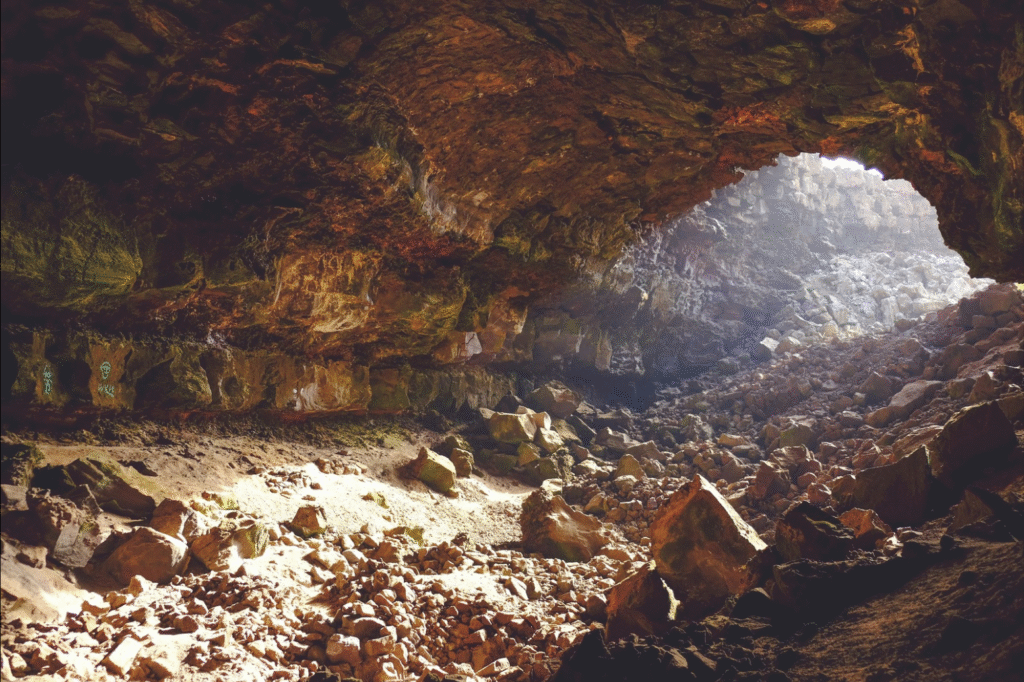
November 21, 2021, marked the start of the Timecave. Flamini entered the cave in Los Gauchos, near Motril in the Spanish province of Granada. The cave descended more than 70 meters (about 230 feet) underground.
Flamini was 48 when she started her mission. Her support team never saw or spoke with her during the 500 days she was underground; contact was limited to supplies and recorded messages exchanged through the narrow shaft.
Flamini was able to send messages through the narrow shaft to people on the outside. She also used two GoPro cameras to capture her daily life underground. They were later used by psychologists, trainers, and speleologists (professionals who study caves) to analyze her health.
Around day 300, the equipment Flamini used to send video and audio updates broke down, forcing her to leave the cave for eight days while it was repaired. She spent that time isolated in a tent near the cave entrance, avoiding all contact with her team, before returning underground.
How Did She Cope With Life Underground?
Flamini kept herself busy to pass the time rather than focus on the emptiness of the underground. She brought 60 books, getting through nearly all of them before returning to the surface. Reading, exercising, painting, and knitting woolen hats were among the activities that helped pass the time underground.
Flamini used almost 1,000 liters of water for drinking, cooking, and personal hygiene. The cave was not always a happy place for her, however. Flies, for example, got into her space on several occasions and required her to develop new coping mechanisms.
Flamini later explained that patience was essential to the experience, and that panic — not isolation itself — was the greatest challenge for someone cut off from others for such an extended time.
How Her Brain Lost Track of Time
One of the most intriguing aspects of Flamini’s Timecave was her loss of time sensation throughout her 500-day solo adventure. Researchers have already established that the sense of time is malleable for humans since we do not have any specific organ that can measure it.
The brain, however, can develop strategies to deal with the concept of time. For instance, we can experience time dilation (when time appears to slow) or contraction (when time appears to quicken) depending on specific circumstances.
The most common explanation for time dilation is that days spent doing new things feel lengthier than those spent doing regular ones. But if you do the same thing every day your brain has less new stuff to store as memories.
Flamini stated that she lost her sense of time around day 65. By day 500, when her crew came to retrieve her from the cave, she believed that just 160 to 170 days had passed. This was not the first time that researchers have observed such a phenomenon.
For instance, a French scientist named Michel Siffre performed numerous underground experiments on the effects of isolation and time perception in the 1960s and 1970s and published his findings in scientific journals.
Siffre, like Flamini, spent two to six consecutive months underground and came out of the cave with an altered sense of time.
Scientists have observed similar time-dilation effects in other documented cases of extended isolation from human contact. Nevertheless, Flamini’s case appears to be the most remarkable because her isolation was both voluntary and significantly prolonged.
Researchers believe that the voluntary nature of her isolation — rather than the isolation itself — may have played a critical role in her experience of time.
As psychologist Ruth Ogden of Liverpool John Moores University, who has written about Flamini’s case, has noted, the fact that her solitude was chosen rather than forced may be an important factor in how she experienced time.
Back Into the Light Again
Her support team climbed down the cave to fetch her on Friday, April 14, 2023. Flamini later revealed to reporters that she had fallen asleep when they arrived. “I was sleeping, or at least I was dozing when they came to get me,” she said.
She was astonished that the 500 days had passed, since she had not yet finished the book she was reading. Flamini was thrilled to see the sunlight again.
She hugged members of her support team before turning to the small crowd that had gathered to watch her exit, joking about wanting to celebrate with friends. She then spent nearly an hour chatting with reporters, saying she needed a shower and looked forward to a plate of fried eggs and chips with friends.
Flamini spoke with reporters again at a press conference shortly after emerging from the cave. “I could do it all again for another 500 days,” she said. Doctors were also on hand to conduct a few medical tests to ensure she was in good health.
Flamini’s blood pressure, nutritional levels, and heart rhythm were all normal, even though she had lost about 12 pounds during her time underground. She had some difficulties walking straight at first but soon overcame them.
Doctors who evaluated her for mental health also did not find any negative effects from her extreme experiment, which left some researchers stunned. Guinness World Records was also there to see if her Timecave marked the longest continuously underground stay of any solo volunteer.
Researchers from the University of Granada, the University of Almería, and Kronohealth (a sleep research company linked to the University of Murcia) continued to study her condition even after she emerged from the cave.
Dokumalia, the production firm that made the Timecave project, began editing the footage it captured of Flamini. In the end, she discovered that the human psyche is much stronger and less lonely than she had anticipated.