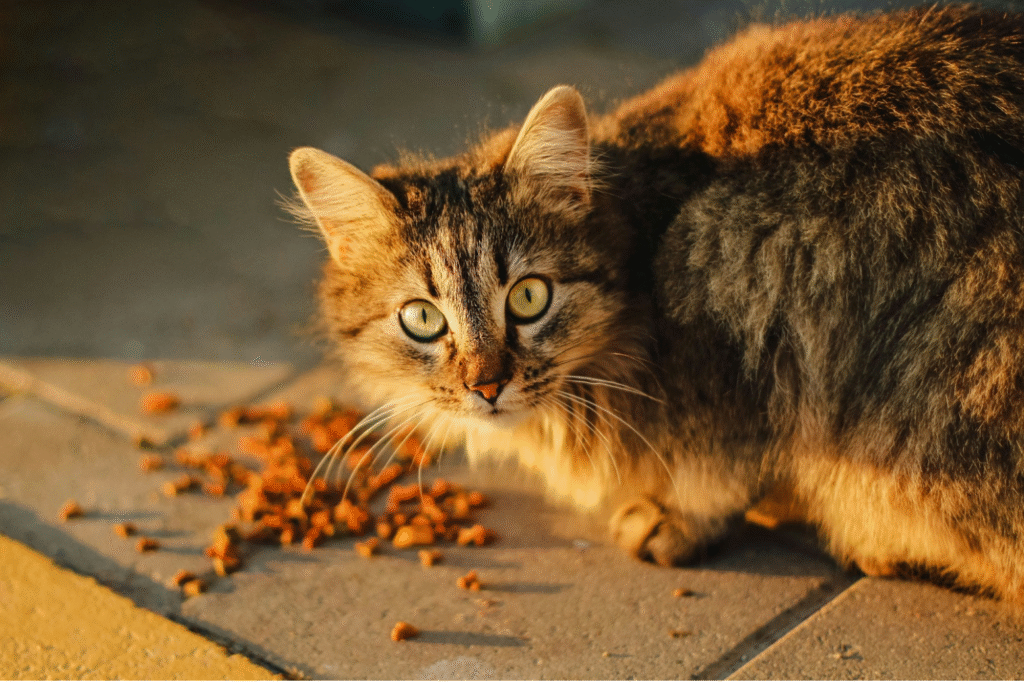
Most cat owners consider that their pets should get fed twice a day, once in the morning and once in the evening. However, according to both home and laboratory experiments, cats tend to eat more frequently than that. In particular, when observing their natural behavior, scientists have found that cats usually eat several times a day.
Researching the home habits of cats
A study conducted by the Waltham Petcare Science Institute based in the United Kingdom revealed fascinating information regarding the eating schedule of cats. Scientists observed the eating habits of 134 cats living in different households.
They did not make any assumptions; instead, they measured the amount of food each cat received and registered each eating session throughout a 24-hour period. As a result, researchers determined that healthy senior cats usually receive 6 or 7 small meals per day.
Scientists also discovered that cats, on average, got fed a similar number of times regardless of the type of their food. In particular, cats, on average, received 6.0 meals of dry food, 6.9 meals of wet food, and 7.2 meals of combined wet and dry food per day.
Thus, it is possible to suggest that cats that are fed with wet food tend to reach their daily caloric intake more slowly due to the higher water and lower calorie content of this type of food. As a result, cats need to return to the bowl more frequently, which leads to more frequent small meals throughout the day.
Researchers also registered the number of calories in order to see if there is a relationship between the type of food and the frequency of meals. On average, the number of calories per day in cats that received dry food was 262.6, while the number of calories per day in cats that received mixed food was 222.6 and the number of calories per day in cats that received wet food was 138.1.
Therefore, there is a correlation between the type of food and the frequency of meals as well as the number of calories consumed. According to the researchers, “these findings support development of evidence-based feeding guidelines for aging cats.”
Regarding the water intake, cats that received wet food drank significantly less water from bowls compared to cats on a dry food diet. However, overall water intake was higher because the water in their food compensated for the amount they drank from bowls.
Extra water in cats’ diet could reduce crystallization in their urine before it passes to the urinary tract, which, according to previous research, could lower the risk of bladder stones.
Moreover, the researchers registered limitations in their study. For instance, they used healthy cats mostly kept at home in order to avoid any differences in feeding. In addition, cats were not picky eaters and received different types of food in accordance with the goals of the experiment.
Researchers took a short-term look at the long-term issue of finding the best way to feed cats because the experiment received funding from Mars Petcare, and all of the scientists that contributed to the research were employed by Mars Petcare groups.
The frequency of meals and feline physiology
According to the domestication theory, cats are predators that have been feeding on small prey such as mice which provide them with approximately 30 kcal per mouse. As reported by veterinary and animal experts, cats are naturally solitary feeders. When allowed to choose how often to eat, they tend to receive 8 to 16 small meals daily (or 10 or more small meals per day when hunting their primary prey in the wild).
The reason why cats should receive several small meals per day is due to the size of their stomachs. A cat’s stomach is relatively small and is better suited to modest portions than to one or two large meals. Therefore, in order to prevent overeating, cats should receive more frequent meals.
Moreover, cats are usually active at dawn and dusk. Thus, in order for them to receive enough food at these times when they are most hungry, they should get fed two or more times per day.
Studies on meal frequency and satiety in laboratories
There are various researches regarding the effect of meal frequency on satiety and the utilization of nutrients. The scientists at the University of Guelph conducted comprehensive research on the topic.
In particular, their study entitled “The daytime feeding frequency affects appetite-regulating hormones, amino acids, physical activity, and respiratory quotient, but not energy expenditure, in adult cats fed regimens for 21 days” was published in PLOS ONE.
Scientists examined how the frequency of meals affected satiety, the use of calories, and the utilization of nutrients when cats were fed once per day and four times per day.
In particular, eight cats living indoors were divided into groups: one group received one meal a day, while the other group received four meals per day with an equal amount of calories. Each cat followed both diets for three weeks.
The scientists discovered that cats that received one feeding per day had elevated postprandial concentrations of several satiety-related hormones, meaning that they felt more full.
In addition, they reported a reduced fasting respiratory quotient indicative of increased lipid utilization and an augmented postprandial increase in systemic amino acid concentrations suggestive of greater protein availability for maintenance and muscle accretion.
Thus, cats that received one meal per day utilized fat and protein in ways that may support lean body mass compared to cats that received four meals per day. According to the scientists, these findings may surprise the veterinary community and many cat owners who have been urged to feed multiple small meals to their cats.
In addition to the aforementioned study, a similar study on the connection between feeding frequency and activity was conducted and published in the Journal of Animal Science.
In particular, the study entitled “Effects of feeding frequency and dietary water content on voluntary physical activity in healthy adult cats” revealed that cats that received more meals per day were more active compared to cats that received only one meal per day. Ten lean adult neutered male cats received an equal amount of calories in accordance with four types of feeding schemes: one, two, four meals per day and randomly scheduled meals per day.
The scientists discovered that cats that received four meals per day were more active throughout daylight time compared to those cats that received only one meal per day. According to the authors, “increasing meal frequency, while maintaining isocaloric intake, increased locomotor activity in neutered male cats which may aid in weight management.”
Another study, published in the Proceedings of the Nutrition Society entitled “Effects of feeding frequency on fasting and postprandial endocrine response in domestic cats” explored the relationship between the frequency of meals and satiety in cats.
Scientists worked with 12 cats and examined how the pattern of feeding (two or four meals/day) during the 24-h period affects postprandial concentrations of leptin, corticosterone, glucose, insulin and ghrelin compared with the control (fasting) state.
According to the scientific paper, cats fed four meals per day had a greater cumulative exposure to leptin than those fed two meals per day. The pattern of feeding had no effect on postprandial concentrations of corticosterone, glucose, insulin, or ghrelin across the 24-h period.
Practical implications and feeding schedule
However, both veterinary guidelines and previous research often recommend feeding cats either once or twice per day, or three to four meals for some individuals.
Kittens should be fed more frequently than adult cats, while senior cats should continue a similar diet to the one followed by adults unless advised otherwise by a veterinarian. However, when a senior cat continues to eat the same amount of food as before without adjustment for activity or health changes, he may experience changes in body condition.
The key to developing the best possible schedule for feeding is to determine the ideal number of meals, as well as the amount of calories in each meal.
The daily food allowance should be the starting point: it can be divided into small measured meals using an automatic feeder or manual portions, allowing the owner to check the cat’s weight and track his feeding pattern. The more carefully measured meals a cat gets, the less chance for overeating or being underweight.
Felines’ individual characteristics should also be taken into consideration. Feeding frequency should be adjusted in accordance with the cat’s natural circadian rhythms.
For instance, cats should receive more food in the morning and in the evening, while the number of meals should stay even throughout the day and the night in order to prevent overeating. In addition to circadian rhythms, other factors such as the amount of activity and the amount of water intake should also be considered.
Multiple small meals often match feline biology better than one or two large feedings, but the best schedule is the one that keeps your cat at a healthy body condition, supports hydration, and fits your household without accidental overfeeding.
Sources
Cats don’t just eat once or twice a day: A new study tracked their real feeding rhythm
University of Guelph / OVC Pet Nutrition. Feeding indoor cats just once a day could improve health
VCA Animal Hospitals. Feeding Times and Frequency for Your Cat
Hill’s Pet Nutrition. Cat’s Natural Feeding Behavior
Cornell University College of Veterinary Medicine. How often should you feed your cat?
Feeding Cats for Optimal Mental and Behavioral Well-Being. PMC
Royal Canin Academy. Feeding behavior in cats
Veterian Key. Feline Ingestive Behavior
Hepper. How Many Stomachs Do Cats Have? Vet-Verified Anatomy Facts
Pet Food Processing. New study explores best feeding guidelines for senior cats