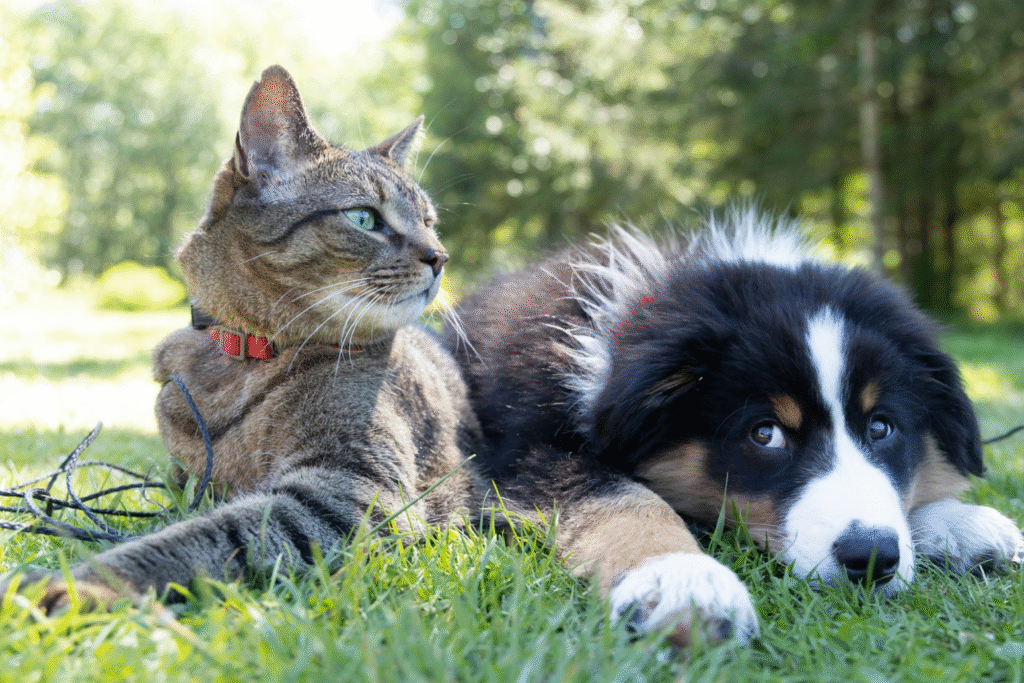
If you have ever dropped something and your dog came to help you while your cat watched indifferently, it was not your imagination. Scientific studies prove that dogs will attempt to help humans while cats do not.
Dogs exhibit traits of younger children when it comes to helping people, whereas cats are more likely to be detached bystanders. These differences stem from biological factors and humans’ historical relationships with the animals.
What the Research Says
Scientists designed controlled experiments in order to determine how dogs and cats would behave when presented with scenarios in which their owners needed help.
According to an article published in the Animal Behaviour journal, scientists created a scenario in which a caregiver pretended to lose an object (a dish-washing sponge). They then observed how untrained dogs, untrained cats, and human toddlers between the ages of 16 and 24 months old reacted.
Over 75 percent of the dogs and toddlers took some sort of action to help the caregiver get the sponge back or to bring it back to them. The scientists also noticed that the dogs would give human-like signals such as looking back and forth at the caregiver and the location of the sponge to show where it was.
The dogs and the toddlers did these things even though the uninteresting sponge was not something they wanted and the toddlers were not rewarded for helping.
“This indicates that the dogs’ inclination to help the caregiver to obtain an object, even though they received no reward or training, and even though the object was irrelevant to the dogs, was strikingly similar to that of human toddlers,” said Melitta Csepregi, a scientist on the study.
The cats, on the other hand, exhibited very different behaviors. Most of them watched the interactions unfold but very few attempted to help. The only time some cats took action was when the item that the caregiver lost was something that they wanted, such as a toy or a treat.
Overall, cats were more likely to be indifferent to the situations or to look out for their own interests rather than those of the human caregiver.
The scientists were careful not to describe the cats as antisocial or cruel, but they were fair in their observations: “This does not mean that cats are aloof or unsympathetic; rather, in the context of these experiments, it seems that most were simply uninterested in helping.”
Another study’s purpose was to investigate how dogs and cats would react if they witnessed another person treating their caregiver poorly. A Kyoto University study showed exactly how dogs are likely to react to unjust situations.
This study’s process involved having dogs watch as their owner tried to open a container with no success. Different actors then intervened in three different ways: they could either help the owner open the container, refuse to help them, or act as if they were indifferent to the situation.
Once these interactions ended, the dogs were given a treat by both the actor that had behaved badly towards their owner and one that had behaved neutrally.
The dogs then exhibited aversion to the person who had been unkind to their owner by refusing to take a treat from them: “The dogs were able to assess the intent of the actor based on his actions and rejected the unfair actor by refusing to take a treat from him.”
When this test was done with cats, the results were completely different. The cats did not exhibit any aversion to the actor that had been mean to their caregiver.
The study’s authors reasoned that this was because cats had not been bred as intensively as dogs to serve humans, as well as because cats “have not been subjected to artificial selection for cooperative work with humans… We consider that cats might not possess the same social evaluation ability as dogs, at least in this situation.”
Why Are Dogs and Cats Different?
The reason why dogs and cats are so different from each other lies in the ways humans domesticated them. Wolves, dogs’ ancestors, are pack animals. For tens of thousands of years, humans have been selecting the wolves that came to them voluntarily, so that they could work with them.
According to research, wolves became easier to train to accomplish human tasks, such as herding animals and keeping watch, then humans took them on as partners in the hunt and in protecting the homestead.
The cats, on the other hand, were never domesticated in the same way. Domestic cats’ wild ancestors lived solitary lives, and their behaviors did not change as dramatically as wolves’.
Around the time of early agriculture, wildcats started making their homes near humans, since humans provided a consistent source of food. According to evolutionary biologist Eva-Maria Geigl, who studied domestic cats by analyzing cat DNA, cats lived independently for thousands of years before they started hanging around humans.
People, in turn, took advantage of cats’ natural inclinations to hunt vermin and were happy to leave them alone. Therefore, the cats never had to develop the same dependence on humans as dogs had.
In summary, the domestication processes of cats and dogs were fundamentally different. “Dogs evolved from highly social ancestors and have been shaped by thousands of years of interaction with humans. By contrast, cats have solitary ancestors and domesticated themselves by settling near human communities. Unlike dogs, they have not evolved to cooperate with humans.”
What This Means for You
All of these things put together explain why you may have found your dog coming to comfort you when you stumbled while your cat did not. In fact, dogs are much more likely to act in ways that suggest that they understand what is happening around them.
Scientists believe that this may be why dogs act similarly to human toddlers when it comes to helping. Emily Sanford, a graduate student at the Johns Hopkins University School of Medicine who studied dogs that rushed to their owners’ aid when they were sad, stated that the dogs who were able to regulate their own internal emotions were able to open the door.
She compared this to how human children were able to demonstrate their social awareness and ability to control their emotions by comforting others: “If a child can do this, so can a dog.”
Of course, this does not mean that cats cannot be caring or empathetic. In fact, many cats develop very strong bonds with their caregivers and demonstrate their affection in their own ways.
As far as interacting with humans goes, dogs may be able to demonstrate more empathy, but they also require more affection. Many people agree that cats are better pets in terms of requiring less maintenance, but there are those that find dogs to be more rewarding companions.
Dogs are generally better at adapting to living with humans, which makes them very affectionate pets. On the other hand, cats are independent in ways that dogs are not which makes them great pets for people who desire companionship but who do not want as much responsibility.
Sources
Dogs avoid people who behave negatively to their owner: third-party affective evaluation
Timmy’s in the well: Empathy and prosocial helping in dogs
Supporting coverage of dog domestication and evolutionary context from National Geographic