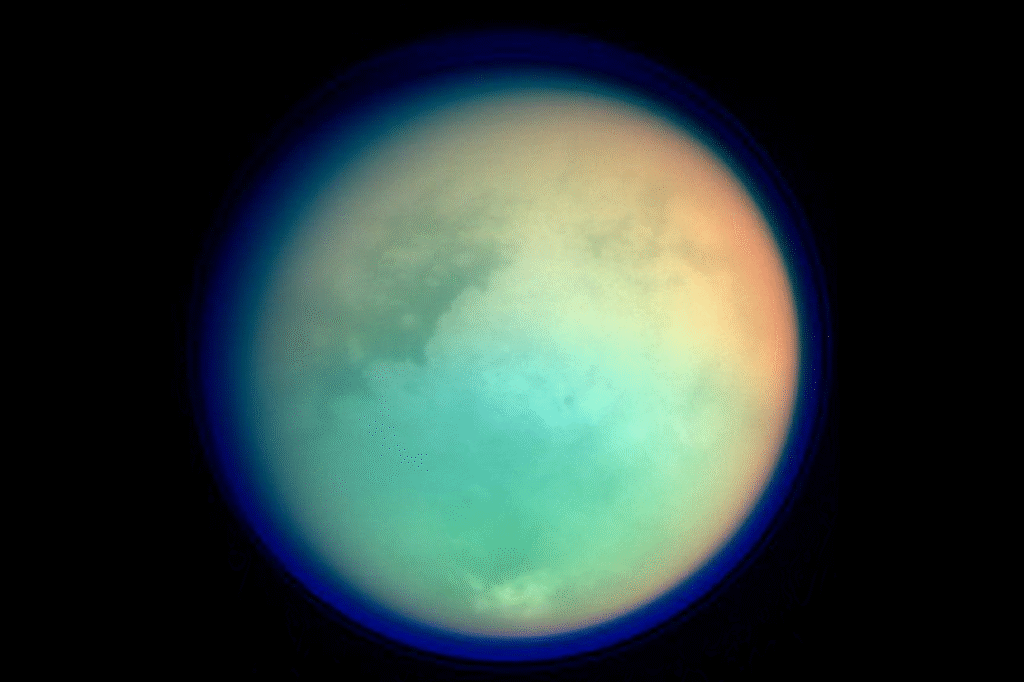
Saturn’s largest moon has rain, rivers, lakes, and seas, just like Earth. But nothing on Titan is made of water. The liquid is methane and ethane, and the ground underneath is frozen so hard it behaves like solid rock.
Titan is the only place besides Earth where scientists have confirmed liquid sitting openly on a surface, and it moves through a weather cycle that looks strangely familiar even though every ingredient is different.
The Chemistry That Makes Titan’s Weather Possible
On Earth, methane and ethane are gases, the kind that power a stove or fill a propane tank. On Titan, the surface temperature hovers around minus 179 degrees Celsius (minus 290 degrees Fahrenheit), cold enough that both chemicals turn to liquid instead of gas.
According to NASA’s Jet Propulsion Laboratory, Titan’s hydrologic cycle works almost exactly like Earth’s, with liquid evaporating, forming clouds, falling as rain, and running off into low ground. The only real substitution is the material doing the work.
Titan’s atmosphere is thicker than Earth’s and made mostly of nitrogen, and it carries a hazy orange smog that blocks ordinary cameras from seeing the surface at all. That haze is the reason radar became the main tool for mapping the moon.
The seas themselves cluster near Titan’s north pole. Kraken Mare, the largest, spans roughly 400,000 square kilometers, big enough to beat out the Caspian Sea, Earth’s largest inland body of water, according to Sci.News.
It was named after the mythical sea monster, which feels fitting for the biggest body of liquid on another world. Ligeia Mare, the second largest sea, covers about 126,000 square kilometers, slightly more than Lake Huron and Lake Michigan combined, and Cassini’s radar sounded part of it to a depth of roughly 170 meters.
A 400-kilometer river system called Vid Flumina feeds into Ligeia Mare through canyons about a kilometer wide and hundreds of meters deep, cut straight into the water-ice bedrock the same way a river on Earth carves through stone.
Farther south sits Ontario Lacus, a smaller lake with a roughly even mix of methane and ethane. Even with all of this, lakes and seas cover only a small sliver of Titan’s total surface, which makes the moon considerably drier than Earth despite its active weather.
Huygens Landed on a Riverbed Nobody Expected
On January 14, 2005, the European Space Agency’s Huygens probe separated from NASA’s Cassini orbiter and dropped through Titan’s haze for roughly two and a half hours before touching down on a plain later named Adiri.
It remains the only landing ever carried out in the outer solar system, and no mission has gone back since. As it fell, the probe’s camera caught branching channels that looked exactly like river valleys, draining into a darker, flatter lowland. That was the first direct sign of a landscape shaped by flowing liquid.
The ground confirmed it. Huygens settled onto a surface scattered with rounded pebbles, roughly 10 to 15 centimeters across, resting in material with the texture of damp sand. Those pebbles were water ice, worn smooth the way a stream tumbles stones on Earth.
NASA’s 10-year retrospective on the landing noted that flash flooding likely sculpted the streambeds at the site, and that the cobbles themselves probably broke free from water-ice bedrock somewhere in higher terrain before washing downhill.
Earl Maize, who managed the Cassini mission at NASA’s Jet Propulsion Laboratory, said the effort represented “a mission of this ambitious scale represents a triumph in international collaboration.”
Huygens kept transmitting for just over an hour after touchdown before its batteries drained, but that short window gave scientists their only ground-level look at Titan to date.
Cassini’s Radar Found Deeper Lakes and Underground Rivers
Cassini itself never landed, but its radar spent more than a decade mapping what Huygens never got to see. On its final close pass by Titan in April 2017, the spacecraft measured several small lakes in the northern hemisphere and found they were far deeper than anyone expected, in some cases more than 100 meters, or about 300 feet, down.
The findings, published in Nature Astronomy, were the first confirmation of both the depth and the makeup of these smaller lakes. Marco Mastrogiuseppe, a Cassini radar scientist at Caltech who led the study, put it: “Every time we make discoveries on Titan, Titan becomes more and more mysterious.”
A companion study in the same journal, led by planetary scientist Shannon MacKenzie at the Johns Hopkins Applied Physics Laboratory, tracked what researchers called transient lakes, bodies of liquid whose levels appeared to shift noticeably between observations.
The most likely explanation was a seasonally driven change in surface liquid, tied to Titan’s rainfall and evaporation patterns over its 29-Earth-year orbit around the sun. The cycle runs on a far slower clock than Earth’s, but the underlying mechanism, wet seasons filling basins and dry seasons draining them, looks familiar.
Cornell’s Jonathan Lunine, who worked on both the Huygens and Cassini missions, added a piece that surprised even seasoned researchers: methane often moves between Titan’s lakes and seas underground rather than only across the surface, seeping through porous ice bedrock the way groundwater does on Earth.
As Cornell’s own reporting on the findings explained, Lunine noted that “the methane travels from the lakes to the seas by subsurface.” In other words, Titan doesn’t just have rivers on top of the ice. It has a hidden plumbing system running beneath it, carrying liquid hydrocarbons instead of water.
A Hidden Ocean, a Live Debate, and a Rotorcraft on the Way
Titan’s water isn’t confined to its icy bedrock. During multiple flybys, Cassini tracked how the moon flexed under the pull of Saturn’s gravity, and that flexing pointed to a liquid layer sitting somewhere between 55 and 80 kilometers beneath the surface.
A 2024 reanalysis led by Sander Goossens at NASA’s Goddard Space Flight Center concluded that this hidden ocean was likely a low-density mix of water and ammonia rather than a dense, heavy brine. Goossens framed why the finding mattered, noting that “liquid water is one of the prerequisites for the emergence of life.”
That picture shifted again in December 2025, when a new study in the journal Nature reanalyzed the same Cassini tracking data and reached a different conclusion.
The researchers found that Titan loses far more energy to tidal forces than a liquid ocean underneath the crust would allow, and argued the moon more likely holds a slushy layer of high-pressure ice rather than an open body of water.
Whether Titan is hiding a true ocean or something closer to wet slush is still an open question in planetary science, and it’s exactly the kind of thing a lander could help settle.
That’s where Dragonfly comes in. NASA’s nuclear-powered, eight-rotor rotorcraft is scheduled to launch no earlier than July 2028 aboard a SpaceX Falcon Heavy, cruise for roughly six years, and arrive at Titan in 2034.
Once there, it will fly between dozens of sites across the moon, including its dune fields and the Selk impact crater, spending more than three years studying the surface chemistry directly instead of from orbit through a wall of haze.
Elizabeth “Zibi” Turtle, the mission’s principal investigator at the Johns Hopkins Applied Physics Laboratory, has described the mission’s real purpose: Dragonfly isn’t searching for life on Titan today, but rather “a mission to investigate the chemistry that came before biology.”
Whatever Dragonfly eventually finds, it will be studying a world built from an entirely different set of ingredients than Earth, running a process, evaporation, rainfall, rivers, lakes, that still looks a lot like home.
Sources
NASA JPL – Cassini Reveals Surprises with Titan’s Lakes
NASA JPL – 10 Years Since the Titan Landing
Cornell Chronicle – Cassini’s Last Titan Flyby Reveals Deep Methane Lakes
Wikipedia – Lakes and Rivers of Titan
Sci.News – Coastlines of Titan’s Largest Seas
Sci.News – Cassini Observations Suggest Underground Ocean on Titan
Nature – Titan’s Strong Tidal Dissipation Precludes a Subsurface Ocean
Johns Hopkins APL – Dragonfly Mission
ExecutiveGov – Dragonfly Enters Integration and Testing Phase