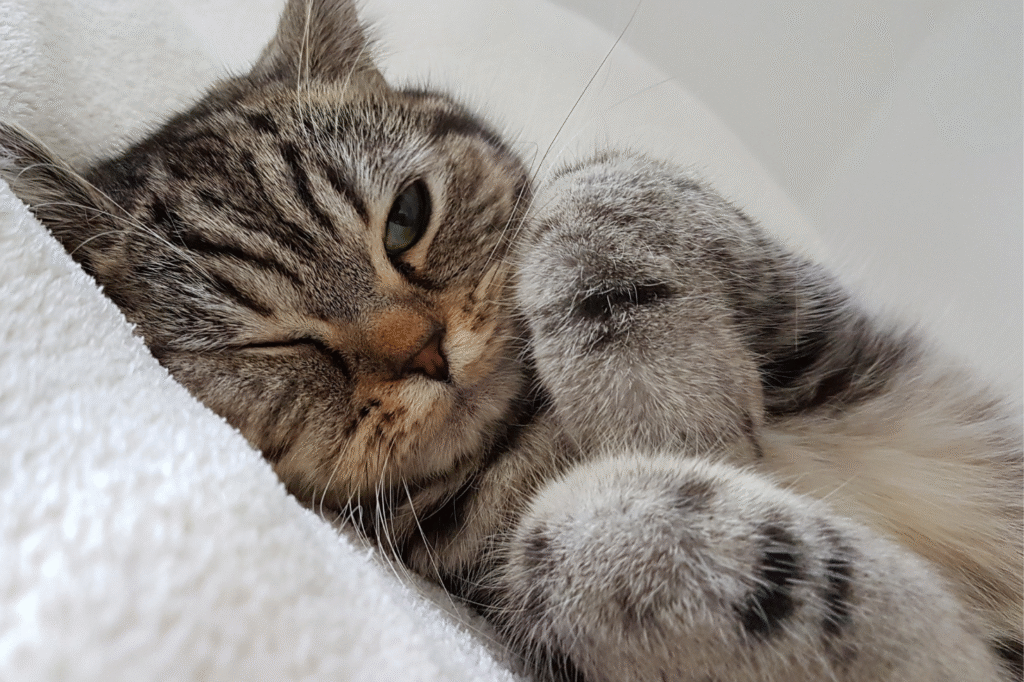
Cats are often seen as aloof creatures, leading many to assume that their distance is by design. In reality, it is frequently because humans fail to perceive the subtle nonverbal communication that cats perform.
A particularly effective signal is slow blinking — a study published in the peer-reviewed journal Scientific Reports confirmed that it communicates friendliness, according to cat behaviour experts.
The “Cat Smile” That You’ve (Probably) Never Noticed
Picture a cat lounging on a couch, gazing at you with half-closed eyes. Slowly, it blinks, closing its eyes for a prolonged moment.
Behaviourists have associated this expression with positivity for years. This narrowing of the eyes has earned itself a nickname: the “cat smile.”
Researchers note that this kind of eye-narrowing echoes the genuine human smile — the so-called Duchenne smile — and shows up in positive contexts across several other species too. The cat’s gaze appears less intense and more relaxed.
A confident, direct stare is unpleasant for many animals to receive. To a cat, a fixed stare can come across as confrontational. Sustained staring can register as overly intense, whereas soft eyes and slow blinks signal safety.
It is analogous to a human smiling gently — a subtle gesture that makes an individual seem more approachable. Small, deliberate movements are the cat’s speciality.
For years, forums regarding cat care recommended slow blinking as a technique to gain a cat’s favour. Anecdotal evidence from cat owners has hinted that humans can copy this expression to communicate to cats that we are friendly and open to interaction.
What the advice lacked, however, was a controlled experiment that could distinguish intention from coincidence.
Two Experiments, One Subtle Trick
Animal behaviour scientists Dr Tasmin Humphrey and Professor Karen McComb of the University of Sussex led a research team through two separate experiments to test the idea. Their findings were published in Scientific Reports in 2020.
Their work was the first to demonstrate experimentally that humans can build rapport with cats simply by narrowing their eyes at them. In the first experiment, 21 cats drawn from 14 households took part, along with their 14 respective owners.
The group was made up of 10 males and 11 females, spanning an estimated age range of roughly five months to 16 years. Testing was carried out inside each cat’s own home rather than in a lab. When a cat looked at its owner, the owner responded with a slow blink from approximately one metre away.
Meanwhile, the control condition involved no interaction at all. This first trial found that cats slow-blinked back at their owners noticeably more often after being slow-blinked at, than during periods when no such exchange took place.
The second experiment involved researchers who were completely unfamiliar to the cats, interacting with 24 cats from eight different households. By observing cat–human interactions, scientists confirmed that this simple gesture makes cats — both familiar and strange — more likely to approach and engage with humans.
In simple terms, slow blinking was effective in engaging a cat’s attention and encouraging it to approach a stranger.
What the Science Tells Us About Cats’ Subtle Signals
The most straightforward explanation for slow blinking is that it indicates peaceful intentions. Narrowing one’s eyes softens the gaze, reducing its intensity and communicating calm. From the cat’s perspective, reduced visual intensity may lower the cognitive load, as the brain does not have to determine whether the other’s body language is unwelcoming.
It could be argued that “cats developed the slow blink behaviors because humans perceived slow blinking as positive.” It’s possible cats have simply learned, over time, that responding to a slow blink tends to be rewarded by their owners.
The Sussex study does not distinguish clearly between instinctual and learned behaviour. However, regardless of cause, slow blinking was shown to have a beneficial social effect on cat–human interactions.
This study fits into a broader trend highlighting feline social cognition. For example, one team ran a habituation-dishabituation experiment to see whether cats could tell apart different human utterances — testing their own names against ordinary nouns and against the names of cats they lived with.
The cats clearly showed a stronger response when listening to their own names than to the words presented before, and this was also true when not the owner but a stranger uttered the cats’ names. This study by Saito et al. was published in Scientific Reports in 2019.
Elsewhere, Merola and colleagues examined how cats communicate with people by placing an unfamiliar, faintly unsettling object nearby and observing a social referencing setup.
Published in Animal Cognition in 2015, the researchers found that when first encountering this odd and potentially unfamiliar object, 79% of cats looked back toward their owners. Cats whose owners conveyed a negative mood looked more toward the exit than cats whose owners were more positive.
Another noteworthy aspect of the Sussex study is the concept of mirroring — a situation in which one individual behaves in roughly the same manner as another did before them.
Cats usually respond better to slow, deliberate movements than to rapid, jerky ones. Subtle gestures are especially useful in developing bonds, because cats are delicate creatures who can be easily overwhelmed.
Finka et al. (2019) also looked at the relationship between the personality of the owner and cat wellbeing with the parent–child relationship as a comparison. Owners who scored higher on the conscientiousness scale had cats that were less reserved or guarded and less aloof/avoidant, but more gregarious.
The findings here support the same principle – gentle, attentive caregiving helps to build better relationships with cats.
How to Use Slow Blinking to Bond With Your Cat
To engage in slow blinking with your cat, take a gentle, relaxed approach — ensure your body posture does not indicate impatience or assertion. Soften your gaze the way you would for a relaxed smile, then let your eyes ease shut for a second or two. Then open them slowly. Repeat this pattern several times, pausing occasionally to observe your cat’s response.
A comfortable cat may blink slowly back at you, or even come towards you. If a cat feels uncomfortable, it may turn away or walk off. Both results should be respected, because the welfare of the cat is paramount.
The practical implications are multifaceted. “Our findings could potentially be used to assess the welfare of cats in a variety of settings, including veterinary practices and shelters.”
In foster care or newly adopted homes, a gentle slow blink enables caregivers to reassure a cat without resorting to more intrusive forms of bonding. Reducing stress in cats is vital, as stressed animals are less healthy overall.
“This study is the first to experimentally investigate the role of slow blinking in cat–human communication,” McComb said. “And it is something you can try yourself with your own cat at home or with cats you meet in the street. It’s a great way of enhancing the bond you have with cats.”
Sources
https://www.nature.com/articles/s41598-020-73426-0
https://www.nature.com/articles/s41598-019-40616-4
https://link.springer.com/article/10.1007/s10071-014-0832-2
https://journals.plos.org/plosone/article?id=10.1371/journal.pone.0211862