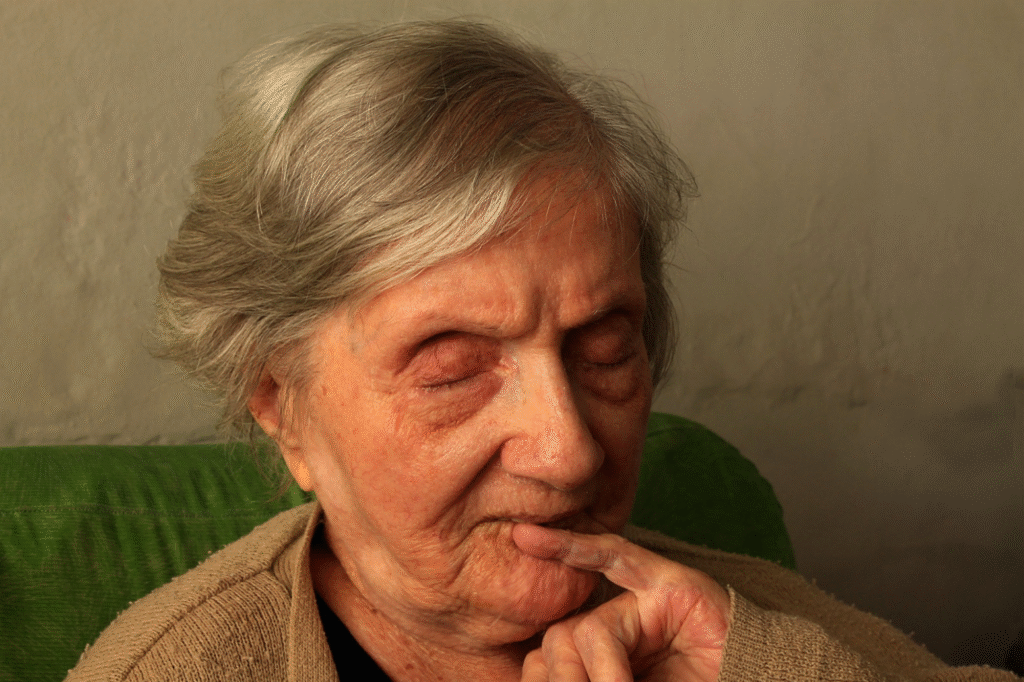
In the final stages of Alzheimer’s disease, families often prepare themselves for the cruel prospect of losing a parent to dementia: a person who cannot recognize familiar faces or follow a simple conversation. Yet, in many care facilities, an old song can often induce an old person to hum or even sing along to a chorus from their youth.
For years, this phenomenon has been puzzling and mysterious. However, modern neuroscience has an answer, and it is fairly straightforward: the brain regions responsible for processing music are among the last to be affected by Alzheimer’s disease.
When Memory Starts to Fade
Alzheimer’s disease is a devastating condition with a range of symptoms that worsen over time. Alzheimer’s patients cannot distinguish past from present. They forget what day of the week it is, and where their home is.
Their short-term memory is severely impaired, in some cases so much so that they can only remember things for a few minutes. Basic conversational rules become difficult to understand and perform routine tasks, and some patients no longer see themselves in the mirror.
On the structural level, the disease primarily targets the hippocampus and entorhinal cortex which play a major role in forming new memories. As the disease advances, damage spreads to the temporal lobes and other cortical regions involved in identity, semantic memory, and higher-level cognitive functions, which is why patients may fail to recognize even their own children.
However, the ability to engage with music a person listened to in their youth often stays intact for longer than the rest of these cognitive functions.
Music That Stays With You
This phenomenon has been observed in care facilities worldwide. When a familiar tune is played for a person with Alzheimer’s, it often provokes a reaction: tapping feet, a flicker of recognition, and sometimes humming or singing along to the chorus. Their performance can be remarkably accurate; a patient who cannot recall breakfast may still produce the exact lyrics of a song from decades earlier.
Musical memory is not a single system but a blend of several. Recognizing a familiar song and knowing how to hum along draws on both semantic memory (knowing the tune is familiar) and procedural memory (the motor skill of singing), while the emotional pull of a song relies on a separate emotional memory system.
Because these systems are distributed across different parts of the brain, musical memory can survive even when other memory systems begin to fail. Episodic memory for music, meaning the ability to recall where and when one first heard a song, tends to be the first to decline, while semantic and procedural musical memory hold up much better as Alzheimer’s progresses.
The 2015 Map of Musical Memory
For years, clinical observations by caregivers were corroborated by neuroscience. A study published in the journal Brain in August 2015 by Jörn-Henrik Jacobsen and colleagues at the Max Planck Institute for Human Cognitive and Brain Sciences in Leipzig, in collaboration with the University of Amsterdam and INSERM in Caen, France, set out to identify where musical memory lives in the brain.
To do this, the researchers used a 7-Tesla functional MRI scanner, powerful enough to detect fine-grained patterns of brain activity in response to sound. In the first part of the study, 32 healthy young adults (16 men and 16 women, average age 28) listened to music that was unknown to them, recently learned, or long familiar from their past.
Two regions stood out as encoding long-known music specifically: the caudal anterior cingulate cortex and the ventral pre-supplementary motor area, both in the frontal lobes. These are not regions classically associated with memory storage; they are more commonly linked to motor planning and cognitive control.
In the second part of the study, the researchers examined those same two brain regions in 20 patients with Alzheimer’s disease and 34 healthy older adults, using structural MRI to measure brain atrophy, FDG-PET to measure metabolic activity, and florbetapir-PET to map amyloid plaque buildup.
The results were striking: these musical-memory regions carried about as much amyloid plaque buildup as the rest of the cortex, showing they were not simply untouched by the disease. Yet the same regions showed noticeably less atrophy and better metabolic activity than would be expected at that stage of amyloid buildup, suggesting they are unusually resistant to the later, more destructive stages of Alzheimer’s pathology.
What This Means for Care Facilities
Now that a link between musical memory and specific brain structures has been established, many care facilities are asking how to put that knowledge to use, and the practice of music therapy has evolved accordingly, from generic background music to individually tailored playlists.
Personalized music therapy tends to draw on songs a person listened to between roughly the ages of fifteen and twenty-five, since musical tastes formed in that window are often repeated and become closely tied to personal identity and memory. For someone with Alzheimer’s, hearing those songs again can be deeply uplifting and help patients engage in more meaningful moments of connection with caregivers and family.
The idea for what became the Music & Memory program was conceived by social worker Dan Cohen in 2006, after he discovered that virtually no U.S. nursing homes were giving residents personalized music on portable devices; he piloted the approach with a handful of iPods at a New York care facility, and the program was formally established as a national nonprofit in 2010. It has since reached thousands of patients and been documented in the 2014 film Alive Inside.
The most common outcome of personalized music therapy is an improvement in mood and a reduction in anxiety; in some cases, patients can even hold brief lucid conversations or sing an entire song from start to finish.
These effects are often short-lived, but they can meaningfully improve quality of life for both patients and caregivers. For families, music can be a reminder that a loved one is still present, even as the disease progresses, offering moments of comfort and normalcy.
Music therapy is not a cure for Alzheimer’s disease, nor can it reverse or halt the disease’s progression. However, the distributed nature of musical memory across different brain regions remains one of the more hopeful findings to emerge from Alzheimer’s research: a part of the mind that, for many patients, stays reachable until very late in the disease.
Sources used
https://doi.org/10.1093/brain/awv135
https://doi.org/10.1093/brain/awv148
https://www.mpg.de/9281090/alzheimers-long-term-musical-memory
https://www.nia.nih.gov/health/alzheimers-symptoms-and-diagnosis/what-are-signs-alzheimers-disease
https://www.nia.nih.gov/health/alzheimers-and-dementia/alzheimers-disease-fact-sheet