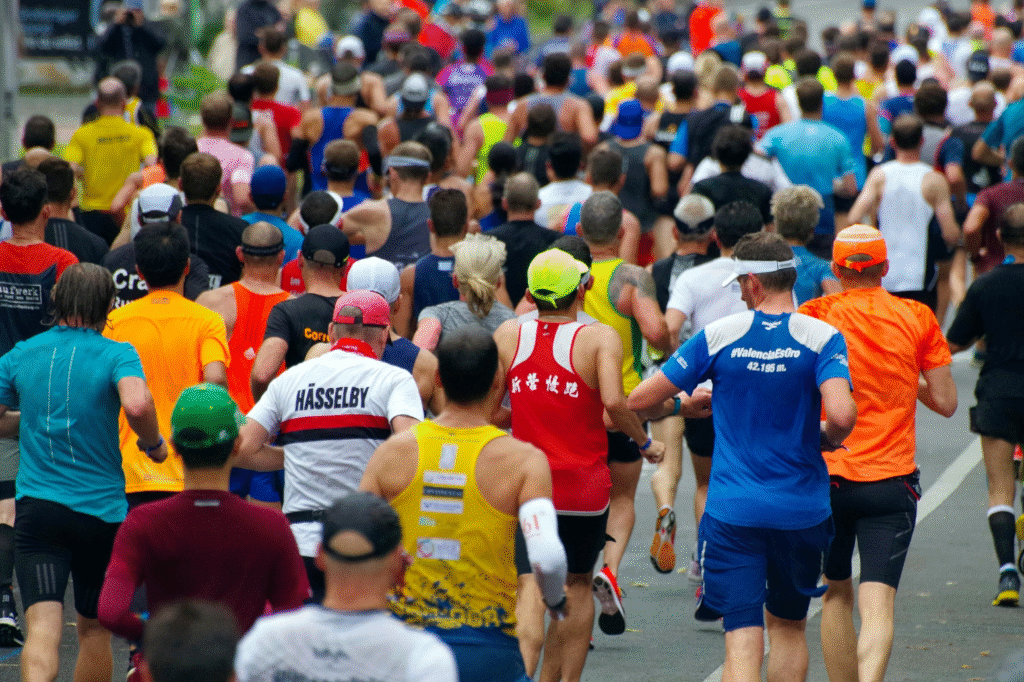
In May 1983, more than 100 elite distance runners lined up in Sydney for the toughest footrace in the country: an 875-kilometer (544-mile) run all the way to Melbourne.
Tagging along near the back was a 61-year-old farmer named Cliff Young, dressed in overalls and work boots instead of racing gear. Days later, Young crossed the finish line first, ten hours ahead of the next competitor, and became one of the most unlikely champions in sports history.
Growing Up Tough in Beech Forest
Cliff Young was born Albert Ernest Clifford Young on February 8, 1922, in Victoria, Australia. He was the third of seven children, and he grew up on a large property in Beech Forest, a small farming town tucked into the hills of southwestern Victoria.
The family worked roughly 2,000 acres of land and kept about 2,000 sheep. Money was tight, especially once the Great Depression hit, and the Youngs could not afford horses or machinery to help manage the farm.
So whenever a storm rolled in, young Cliff went out on foot to round up the flock, sometimes running after them for two or three days without a real break.
He explained it years later: “I grew up on a farm where we couldn’t afford horses or tractors.” Those long, tiring chases across the paddocks quietly built the kind of endurance he would rely on decades later.
A Late Start in Competitive Running
Young did not try organized racing until he was well into middle age. In 1979, at 56, he entered the Adidas Sun Superun, a race across Melbourne’s West Gate Bridge, and finished in 64 minutes, which was strong enough to catch the attention of local reporters.
That same year, he ran the Melbourne Marathon in just over three hours and twenty minutes. He came back the next year and cut his time down to 3 hours, 2 minutes, and 53 seconds, an impressive personal best for a 58-year-old. Encouraged by the progress, Young set his sights on something far bigger.
He began training through the Otway Ranges near his home, aiming to break the world record for running 1,000 miles, a mark held at the time by New Zealand’s Siegfried “Ziggy” Bauer.
In late 1982, he attempted the record in Colac, Victoria, but his small support crew lacked experience, and he had to stop just past the halfway point, at around 500 miles. The attempt fell short, but it taught him hard lessons about pacing and recovery that he carried straight into the following year.
Lining Up Against the Professionals
The 1983 Westfield Sydney to Melbourne Ultramarathon was the first race of its kind, running between two of Australia’s largest shopping centers at the time: Westfield Parramatta near Sydney and Westfield Doncaster in Melbourne.
The field was stacked with trained ultra-runners, many backed by sponsors and dressed in the latest gear. Young stood out immediately. He showed up in farm overalls and rubber work boots, and he left his dentures behind because they rattled too much while he ran.
Someone in the crowd handed him a proper pair of running shoes before the starting gun, and he wore those instead of his boots. Once the race began, his slow, shuffling gait put him far behind the leaders by the end of the first day.
The route itself was brutal, baking the runners in daytime heat and then dropping to near-freezing temperatures once night fell along the highway. Race organizers doubted Young could keep pace with the professional field, let alone make it to Melbourne at all.
The Sleepless Strategy That Changed the Race
At the time, nearly every competitor followed the same unwritten plan: run for about 18 hours, then sleep for six before starting again. Young had never heard of that routine. On the first night, he lay down like everyone else, but he woke by accident around 2 a.m., several hours earlier than planned.
Instead of going back to sleep, he got up and kept moving, quietly passing several rivals who were still resting. That accident turned into his strategy for the rest of the week: he stayed on his feet and skipped sleep completely for five straight days.
Young later said that during the hardest stretches, he pictured himself back on the farm, chasing sheep ahead of an approaching storm. His running style also set him apart. Rather than the long, bouncing stride used by trained marathoners, he kept his feet low and close to the ground in a loping shuffle that burned far less energy.
Reporters nicknamed it the “Young Shuffle,” and at least three later winners of the same race would adopt a version of it. Young reached Melbourne in 5 days, 15 hours, and 4 minutes, an average pace of about 6.5 kilometers per hour.
That time beat the previous record for the route by nearly two full days, and every one of the six runners who finished that year broke the old mark as well.
The Prize Money and the Legacy That Followed
When officials told Young he had won the top prize of 10,000 Australian dollars, he seemed genuinely caught off guard; he hadn’t even realized there was money on the line.
He and fellow finisher Joe Record, 41, had made an informal deal before the race to split any winnings if either of them came first, but once Young crossed the line, he started handing cash to nearly everyone who had finished behind him.
“I forgot about Joe and started giving it away left, right and center,” he said afterward. By the end, four of the runners had shared 4,000 dollars between them, Record still received his promised 3,000, and Young kept only 3,000 for himself, feeling the others had worked just as hard as he had.
The win turned Young into a national hero almost overnight, often described as a real-life tortoise beating the hare.
The town of Colac, where his 1,000-mile attempt had failed the year before, founded the Cliff Young Australian Six-Day Race in his honor that same year, and in 1984 the Australian government awarded him the Medal of the Order of Australia for long-distance running. He kept competing well into old age.
In 1997, at 75, he set out to break the record for running the entire coastline of Australia to raise money for homeless children, covering about 6,520 of a planned 16,000 kilometers before pulling out because his only support crew member fell ill.
Two years later, at the 1999 Coburg 24-Hour Carnival, a storm rolled through the course in the evening and sent most of the other competitors running for cover; Young, then 77, leaned forward into the wind and rain and kept moving, eventually covering 147 kilometers before the event ended.
In 2000, at 79, he went on to set a world age record in a six-day race in Victoria. Fellow competitor John Connellan later summed up how the country came to see him: “He was a little fella who became larger than life.”
Young married Mary Howell, then 23 years old, shortly after his historic win, and the race sponsor, Westfield, even hosted the wedding as entertainment for its shoppers. The marriage ended in divorce five years later. Young had been a vegetarian since 1973 and kept that habit for the rest of his life.
He passed away at his home in Queensland on November 2, 2003, at the age of 81, having covered more than 20,000 competitive kilometers over his running career.
Australia still remembers him through a gumboot-shaped memorial in Beech Forest, a 2013 television movie called “Cliffy” that introduced his story to a new generation, and a 2010 comedy festival show that borrowed his nickname as its title.
Sources
Sydney to Melbourne Ultramarathon
Cliff Young Australian 6-day race
Cliff Young, The 61-Year-Old Potato Farmer Who Won A 544-Mile Ultramarathon
Cliff Young Gave Us a Whole New Way to Run Long Distances
Australian Story: “Born to Run” (Cliff Young)
Cliff Young – 61 yr old farmer who Won the World’s Toughest Race