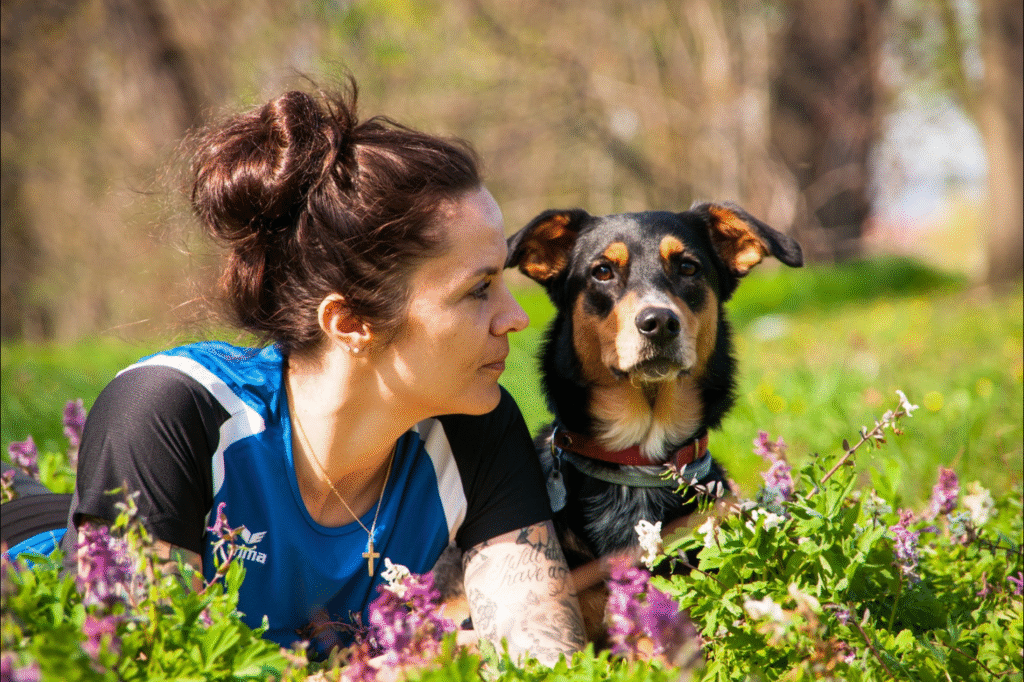
Ask any dog owner if their pet feels like family, and most won’t hesitate to say yes. Brain scans now back up that feeling.
In 2014, researchers at Massachusetts General Hospital found that when mothers looked at photos of their dogs, several of the same brain regions lit up as when they looked at photos of their own children.
The discovery didn’t just confirm what pet owners already knew in their gut. It gave scientists a real, measurable starting point for studying the biology behind the human-dog bond.
Inside the Brain Scan Study
The research team, led by Luke Stoeckel and Lori Palley, published its findings in the journal PLOS ONE. For the study, they recruited 14 mothers, each with at least one child between ages 2 and 10 and a dog that had lived in the household for two years or more.
The process ran in two stages. First, researchers visited each woman’s home, photographed her child and her dog, and asked her questions about both relationships. Next, each mother traveled to MGH’s Athinoula A. Martinos Center for Biomedical Imaging for a functional MRI, or fMRI, scan.
This type of scan tracks blood flow in the brain, showing which regions are working hardest at a given moment. While lying in the scanner, each participant viewed a rotating set of photos: her own child, her own dog, and an unfamiliar child and dog belonging to another participant in the study.
The results, reported by Harvard’s news office, showed a shared network of brain regions responding to both sets of “own” photos, covering areas tied to emotion, reward, affiliation, visual processing, and social thinking. Differences showed up, too.
A structure called the substantia nigra/ventral tegmental area, known for its role in bond formation, activated only in response to child photos. The fusiform gyrus, a region tied to facial recognition, actually responded more strongly to dog photos than to child photos.
Mothers rated both sets of “own” photos as similarly exciting and pleasant to view, though the emotional gap between her own child and an unfamiliar child ran larger than the gap between her own dog and an unfamiliar dog.
Palley, a doctor of veterinary medicine at MGH’s Center for Comparative Medicine, summed up the motivation behind the work: “Pets hold a special place in many people’s hearts and lives.”
Her team’s imaging data gave that idea a biological foundation, showing that the pull people feel toward pets isn’t just sentiment. It runs through some of the same neural circuitry that supports the parent-child bond.
The Chemistry That Fuels the Bond
Brain imaging tells only part of the story. A year later, a separate research team in Japan, led by Miho Nagasawa at Azabu University, turned to a different piece of evidence: the hormone oxytocin, often called the bonding hormone because levels surge during nursing and skin-to-skin contact between a mother and her newborn.
Published in the journal Science, the study found that dogs and their owners who held eye contact for longer stretches both showed matching rises in oxytocin during the interaction.
A longer gaze from the dog led to a bigger oxytocin jump in the owner, which in turn encouraged more affectionate behavior from the owner, which then raised oxytocin levels in the dog as well.
That pattern didn’t show up between wolves and their human handlers, even ones raised and socialized the same way as the study’s dogs.
Researchers see this as evidence that the gaze-driven oxytocin loop developed specifically during the thousands of years dogs spent evolving alongside humans, rather than being a trait dogs simply inherited from their wolf ancestors.
Some scientists have since raised questions about parts of the study’s design, including a small wolf comparison group and differences in how male and female owners respond to oxytocin, so researchers are still working to pin down exactly how strong and universal the effect is.
Even with those open questions, the core idea lines up with the MGH brain scans: the same biological systems that bond a mother to her infant also activate, at least in part, when a person and a dog make eye contact.
Why This Shows Up in Everyday Life
These lab findings track with what public health research has shown for years. In 2013, the American Heart Association published a scientific statement reviewing the existing research on pets and cardiovascular health.
Dr. Glenn Levine of Baylor College of Medicine, who chaired the committee behind the statement, said pet ownership is, as he put it, “probably associated with a decreased risk of heart disease.”
The review tied pet ownership, especially dog ownership, to lower blood pressure, improved cholesterol numbers, more physical activity, and a reduced stress response. Separate research reviewed by the National Alliance on Mental Illness found that pet ownership is linked to less isolation and loneliness.
More recent survey data adds another layer. A 2024 poll conducted by Morning Consult for the American Psychiatric Association and the American Veterinary Medical Association found that most pet owners believe their pet benefits their emotional health.
APA president Petros Levounis, commenting on the poll results, described pets as “a source of companionship, comfort, love, and friendship,” and noted he often recommends pet adoption to patients recovering from addiction.
The Human Animal Bond Research Institute tracks the physiological side of these interactions, documenting shifts in cortisol, oxytocin, dopamine, heart rate, and blood pressure during positive time spent with animals.
None of this happens by chance. It lines up with what the brain scans and hormone studies already suggest: physical closeness with a pet taps into the same systems that reward and reinforce close human relationships.
What Scientists Still Want to Know
None of this means a dog is a stand-in for a child, and the MGH researchers were careful to say so. Their sample was small, just 14 women, and every participant was already a mother.
That leaves open questions about whether fathers, people without children, or owners of other kinds of pets would show similar brain activity. Because fMRI scans track blood flow rather than measuring neural activity directly, they can show which brain areas are active during a task, but they cannot fully explain why, or prove a direct cause-and-effect relationship on their own.
The research team has said future studies would need larger and more varied groups, including fathers, adults without children, and adoptive parents, to see how far these brain patterns extend.
The oxytocin research out of Japan faces a similar call for replication, with some scientists asking for bigger wolf comparison groups and closer attention to how an owner’s gender affects hormone results.
Even with those open questions, the direction of the evidence has held steady across a decade of follow-up work.
Brain imaging, hormone research, and large-scale health surveys all point toward the same conclusion: the connection between a person and a dog draws on real, measurable biology, not just a warm feeling.
For the millions of people who already treat their pets like family, the science has simply caught up to what they knew all along.
Sources
Patterns of Brain Activation when Mothers View Their Own Child and Dog: An fMRI Study
Mothers’ brains show similar responses to her baby and her dog
Oxytocin-gaze positive loop and the coevolution of human-dog bonds
Pet Ownership and Cardiovascular Risk: A Scientific Statement From the American Heart Association
The Remarkable Human-Animal Bond
‘The pet effect’: Exploring research on the human-animal bond