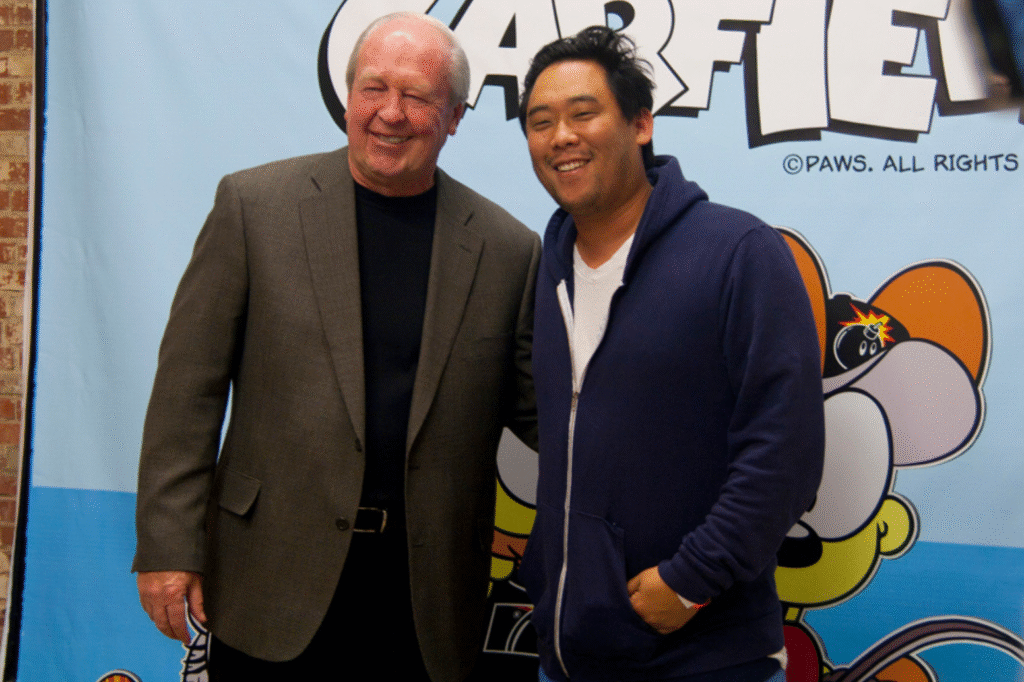
Like many of those getting rich, David Choe could have amassed a fortune through years of diligent savings or by developing and then selling a business.
However, the young artist’s experience was different, as he exchanged his underground reputation for the stock of a significant company, which is now worth billions of dollars. Choe’s client was the social media giant Facebook, and the compensation for the artist’s work turned out to be priceless for him.
From Koreatown Streets to the Art World
David Choe was born in Los Angeles in 1976 to Korean immigrant parents. He grew up in Koreatown and got into trouble during his teenage years for spray-painting on the walls of local stores.
His artistic style, which is described as raw and energetic, was developed through constant practice and drawing in the streets, though he also briefly attended the California College of the Arts before dropping out.
In 1996, the artist self-published his first graphic novel called Slow Jams, which shows the development of his style, as well as his unconventional approach to distributing his art. In the following years, he gained popularity for his distinct aesthetic.
On Wikipedia, one can find his style referred to as connected to the underground mural and illustration scenes in the 2000s. In the early 2000s, his art appeared in magazines such as Vice, and he described his approach as “dirty style.” The term aimed to define art that embraced rough edges, sharp emotions, and a certain controlled chaos.
Due to Choe’s growing recognition, he soon became a favorite among the tech elite who aimed to transform their bland corporate environments into something extraordinary. In 2005, the artist received an offer that would change his life, as Sean Parker invited him to paint the walls of the Facebook office in Palo Alto.
At the time, the company was still relatively unknown, and the task seemed like nothing more than a mural job for a fledgling startup.
Choe did not see the company as any great opportunity, as he considered the idea of a social network ridiculous and pointless. Nevertheless, he took the job, as he thought it was a decent-paying assignment. When it was time to set the price, Choe asked for $60,000.
On Howard Stern’s radio show, he recalled that the figure reflected the rising demand for his services, noting “it was going to be 60… you know, 60 grand,” as reported by CNBC.
In turn, Parker offered to pay him in cash or shares of Facebook stock, which amounted to roughly the same sum. The deal was thus in line with the norms of the art market, as the artist received a fair price for his services.
Parker’s offer was a bold one, as it involved betting on the success of an unproven startup. Choe took a tremendous risk by accepting the shares, as Facebook had yet to prove itself. Two years later, in 2007, Zuckerberg hired him again to paint somewhat tamer murals for the company’s next office.
According to KQED, these works were less exaggerated and more restrained than the originals. In the following years, as Facebook relocated, the paintings were carefully carved out of the walls and reinstalled at the new headquarters.
The IPO That Changed Everything
In 2012, Facebook went public, meaning its stock became available for purchase and its value could be assessed by anyone. Choe’s share of the company was estimated at between 0.1% and 0.25%, and when the IPO priced at $38 per share, his holdings were valued at approximately $200 million.
This staggering figure was widely reported by outlets including the New York Times.
Many individuals made substantial sums from the Facebook IPO, including Peter Thiel, one of the first investors who backed the project early on, and Marc Andreessen, who reaped enormous benefits as the network grew into one of the most valuable technology companies in history.
However, Choe was one of the few unexpected figures to benefit so massively. While the technology elite had engaged in a competitive race to build the best products, the artist had simply agreed to paint some walls. The sudden fame stripped him of the privacy he had previously enjoyed, as tabloids and inquisitive reporters continued to pursue him.
Life After the Windfall
Following the IPO, Choe continued to lead his life in an unconventional manner. In 2014, he surprised the public by finding $100,000 in a shoebox in his room, which he decided to give away via an elaborate, nationwide scavenger hunt.
The winner would receive the prize money, a flight to Los Angeles, and a custom painting from the artist. In 2017, he debuted his immersive, invite-only exhibition, “The Choe Show,” in Los Angeles.
As Hyperallergic put it . . . “a limited number of people were permitted to attend, with applications required for invitations and an extensive screening process. Visitors also had to sign a non-disclosure agreement and follow strict rules, including not participating in certain activities for 12 hours before the opening.
These efforts enabled Choe to create an immersive art experience that expanded his artistic vision beyond the canvas.
As of this writing, the artist remains committed to the pursuit of his passion for making art. His works are sold on Artnet and MutualArt. He also shares his art and opinions on his website and on his YouTube channel. His stock in the company is doing well.
In late 2021, Facebook changed its name to Meta Platforms and the stock, which debuted at $38, has risen sharply, a fitting payoff for what started out as an assignment to paint a mural.
David Choe’s story is still one of the most extraordinary things to have happened in the Silicon Valley landscape, where an artist became fabulously wealthy off one well-timed decision. There was nothing complicated to do, and no special skill was required, except to ask a fair price for his services.
Ultimately, a mural-painting job for a relatively unknown social networking company resulted in him earning hundreds of millions of dollars, positioning him as one of the most extraordinary examples of achieving financial success through an unconventional route.
Sources
How Facebook graffiti artist David Choe earned $200 million
Facebook Graffiti Artist David Choe Gets His 15 Minutes and $200 Million Worth of Fame
Stuck Outside David Choe’s Secret Show